By Abdulkarim Abdulmalik
In the crowded theatre of global diplomacy, alliances are often forged through power, proximity, or necessity. Yet, sometimes, history surprises us with a quieter, more profound story—one rooted not in dominance, but in foresight and goodwill. Such is the story of how Morocco, a Muslim kingdom on the edge of North Africa, became the first country to recognize the United States of America long before it fully became the nation we know today.
The year was 1777. Across the Atlantic, thirteen fragile colonies were locked in a desperate struggle against the British Empire. The idea of an independent America was still uncertain, almost fragile—more aspiration than reality. Yet, thousands of miles away, Sultan Mohammed III was already paying attention.
Rather than waiting for the dust of war to settle, the Moroccan ruler made a bold and visionary decision. He declared that American ships could freely enter Moroccan ports. It was more than a maritime courtesy—it was a diplomatic signal. In effect, Morocco recognized the United States as an independent entity at a time when even many European powers hesitated.
This act was not merely symbolic. It carried weight in an era when international recognition could determine whether a fledgling nation survived or faded into history. Morocco’s gesture sent a message: America was no longer just a rebellious cluster of colonies; it was a nation-in-the-making.

For many, this moment remains one of the most overlooked chapters in early American history. The narrative of U.S. independence often centers on familiar European allies like France, whose military and financial support proved decisive. But Morocco’s recognition predates those formal alliances, making it the first country—Muslim or otherwise—to extend a hand of acknowledgment.
Why did Morocco act so early? Historians suggest a blend of pragmatism and principle. Morocco was a seasoned trading nation with deep ties across the Mediterranean and Atlantic. Recognising the United States early meant opening new channels of commerce and influence. But beyond economics, there was also an element of strategic independence. By engaging with the emerging American state, Morocco demonstrated its own sovereignty in foreign policy, free from European pressures.
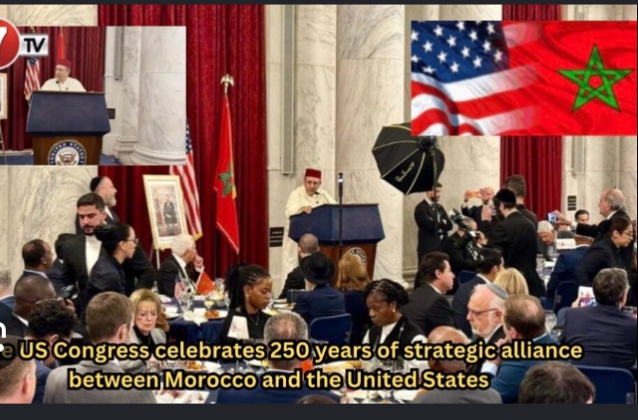
The relationship did not end with that initial gesture. In 1786, the two nations formalized their ties through the Moroccan–American Treaty of Friendship, a document that has endured through centuries of political change. It remains one of the longest-standing unbroken treaties in U.S. history—a quiet but powerful testament to a relationship that began before America had even found its footing.
Today, this shared history is symbolized in small but meaningful ways. In Washington, D.C., the Moroccan legation—now a historical site—stands as a reminder of that early connection. It tells a story not just of diplomacy, but of mutual respect between two nations separated by geography, culture, and language.
Yet, beyond the facts and dates, there is something deeply human in this story. It is the story of recognition—of seeing potential before it is fully realized. When Morocco acknowledged the United States in 1777, it was not endorsing a finished product. It was recognizing a possibility, a vision still taking shape amid uncertainty.
In a world often divided by suspicion and rivalry, this early act of goodwill offers a different lesson. It reminds us that relationships between nations do not always begin with treaties and summits. Sometimes, they begin with a simple decision to trust, to engage, and to acknowledge the humanity on the other side.
For Nigeria and other nations navigating complex interfaith and international landscapes, this story carries particular relevance. It challenges simplistic narratives about relations between Muslim-majority countries and the West. Long before modern geopolitics complicated these interactions, a Muslim kingdom extended one of the earliest gestures of diplomatic recognition to a Western nation still in its infancy.
As global tensions continue to shape perceptions between cultures and civilizations, the Morocco–America story stands as a counter-narrative—one rooted in cooperation rather than conflict. It invites us to reconsider how history is told and whose contributions are remembered.
More importantly, it asks a timeless question: What does it mean to recognize another nation—or even another people—before the world fully believes in them?
Back in 1777, Sultan Mohammed III answered that question not with words, but with action. And in doing so, he secured Morocco a unique place in the story of America’s birth—a place not defined by power, but by vision.
In an age where recognition often comes late and grudgingly, Morocco’s early gesture still echoes. It is a reminder that sometimes, the first to believe in a new idea can shape its destiny in ways history never forgets.