From Taiye Joseph, Ilorin
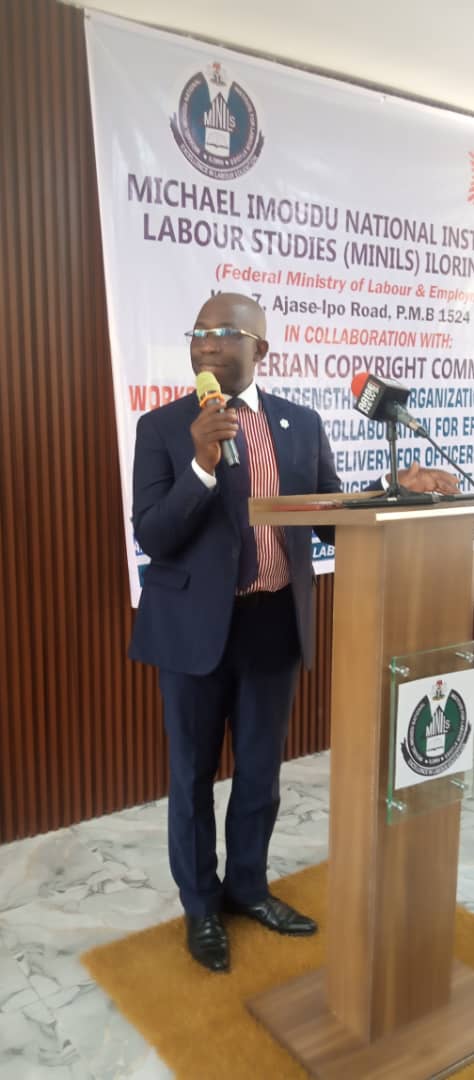
The Nigerian Copyright Commission (NCC), in collaboration with the Michael Imoudu Institute of Labour Studies (MINILS), has trained over 100 senior officers in Ilorin on effective regulatory service delivery, as part of efforts to strengthen copyright enforcement and adapt to the digital economy.
The five-day workshop brought together participants from across the commission, with the NCC leadership stressing the need for improved awareness, compliance and institutional efficiency in tackling copyright violations in Nigeria’s fast-evolving creative space.
Speaking at the opening session, the Director-General of the NCC, Dr John Asein, said many Nigerians still operate under the wrong impression that content found online is free for unrestricted use, warning that such assumptions continue to undermine the creative industry.
He also noted that key users of copyrighted materials, including broadcasters and hotels, often fail to meet their payment obligations despite clear regulations.
Related News
According to him, recent legal reforms now allow the commission to resolve copyright offences through fines, a development aimed at reducing the delays associated with prosecution in court. However, he warned that low public awareness remains a major setback.
Asein said the commission was repositioning itself for greater efficiency in the digital era and would sustain staff development programmes annually as part of institutional renewal.
“The one thing I can assure you is that just as we are asking you to do more, we will also do more to make it easier for you to give us what we expect to make Nigeria better and of course, to ensure that the renewed hope that we are all part of is realised in our time,” he said.
He also urged rights holders not to relent in the fight against piracy, noting that illegal consumption of creative content poses a serious threat to Nigeria’s cultural and economic future, especially for young people.
Asein further highlighted collaboration with MINILS as a strategic step toward addressing emerging labour and digital challenges, while commending the media for its support and urging stronger advocacy on intellectual property protection.
On inclusivity, he said the new copyright framework now provides stronger safeguards for persons with disabilities.
“In life, there will always be areas of strength, areas of weakness, but if you bring them together, you can synergize and have a strong institution,” he added.
Minister of Labour and Employment, Muhammad Maigari, represented by the Kwara State Controller, Mr Michael Orodiran, commended the NCC for investing in staff development and urged participants to maximise the opportunity for learning and improved service delivery.
Earlier, the Director-General of MINILS, Comrade Issa Aremu, represented by Dr Michael Raji, welcomed participants and described the turnout as unprecedented, saying it reflected strong interest in capacity building within the commission.
He noted that the programme was designed to encourage innovation and practical thinking rather than routine lectures, adding that participants should apply the knowledge gained in their duties.
Participants at the workshop expressed optimism about the impact of the training. Mrs Kehinde Adeshina said she attended with high expectations, noting that she was eager to acquire new skills to improve her performance at work.
Another participant, Mr Amos Abutu, described the programme as a valuable staff development initiative, saying it would enhance productivity and career growth within the commission.