From Taiye Joseph, Ilorin
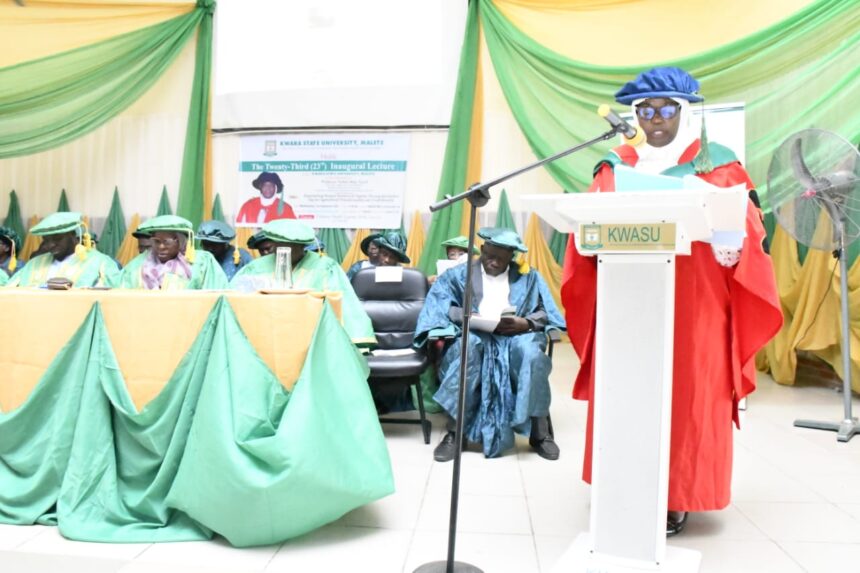
Nigeria’s battle against food insecurity may persist unless women farmers are given better access to land, affordable credit, modern technology and agricultural support services, a Professor of Agricultural Economics at Kwara State University (KWASU), Taibat Moji Yusuf, has warned.

Yusuf gave the warning while delivering KWASU’s 23rd Inaugural Lecture titled, “Empowering Women Farmers in Nigeria: Closing the Gender Gap for Agricultural Transformation and Food Security.”
The don said Nigeria could not achieve meaningful agricultural transformation while a significant proportion of women involved in farming continued to face structural barriers that limited their productivity and economic independence.
Related News


She called for urgent reforms to land ownership and inheritance practices to guarantee women the right to own and inherit agricultural land regardless of their marital status.
Yusuf also advocated joint land titling for married couples, saying discriminatory customary practices had continued to deny many women access to productive agricultural resources.
She said community sensitisation was necessary to challenge traditional patrilineal inheritance systems that often placed women at a disadvantage.
On agricultural financing, the professor urged government and financial institutions to expand microcredit schemes that do not depend heavily on land collateral, noting that many women farmers lacked titled property to secure conventional loans.
She called for flexible loan products tailored to the realities of women farmers, alongside the expansion of digital financial services to reach women in remote rural communities.
Yusuf also identified weaknesses in agricultural extension services as a major constraint to women farmers.
She recommended the recruitment of more female extension officers and the adjustment of training schedules to accommodate women’s domestic responsibilities.
She further proposed mobile-based agricultural advisory services delivered in local languages to enable rural women to access timely information on improved farming practices.
According to her, investment in rural infrastructure, including water supply, electricity and childcare facilities, would reduce the burden on women and give them more productive time for farming and agribusiness.
She also advocated increased access to mechanised processing equipment and other labour-saving technologies suited to the needs of women farmers.
“Adult literacy programmes, agricultural training and support for cooperative societies will enhance management skills, adoption of technology and bargaining power,” she said.
The agricultural economist said Nigeria should also promote income diversification among rural women through agro-processing, entrepreneurship and off-farm employment.
She noted that improved rural roads, electricity and information and communication technology would enable women to withstand agricultural shocks while creating alternative income opportunities.
Yusuf called for stronger public-private partnerships to expand contract farming and agricultural credit programmes.
She said existing initiatives, including the Anchor Borrowers’ Scheme, could be strengthened to provide farmers with reliable markets, inputs and financing.
She also urged increased investment in post-harvest storage, transportation, cold-chain facilities and market information systems, saying such measures would reduce food losses and enable women farmers to earn more from their produce.
The professor further advocated the adoption of environmentally friendly agricultural technologies, particularly moringa-based bio-organic fertiliser technology, through extension services, cooperative networks and soil fertility programmes.
She called for community-based moringa cultivation to guarantee a steady supply of raw materials for the technology.
Yusuf urged the government to make gender impact assessments compulsory in the design and implementation of agricultural policies and programmes.
She also called for greater representation of women on agricultural policy committees, boards and farmer unions, as well as dedicated funding for gender-responsive agricultural investments.
The don said the government must address agriculture alongside employment, education and health, stressing that food insecurity was closely linked to wider socio-economic conditions.
“With 140 million Nigerians living below the poverty line, coordinated cross-sector action is urgent,” she said.
Yusuf maintained that closing the gender gap in agriculture would improve the livelihoods of women and their families, increase agricultural productivity and strengthen Nigeria’s capacity to achieve sustainable food security.
Her recommendations were based on more than three decades of field research into the economic realities and challenges confronting farmers and Nigeria’s agricultural sector.