By Joy Salami
Kogi State Government, is targeting no fewer than 240,000 school-aged children, when it commences the 2026 Mass Administration of Medicines (MAM), campaign against Schistosomiasis, an acute and chronic Neglected Tropical Disease (NTD), caused by parasitic worms, in 15 Local Government Areas of the state.
The initiative will involve the Kogi State Ministry of Health, in collaboration with Sightsavers and the Federal Ministry of Health and Social Development, with drug distribution scheduled from 22nd to 30th June, 2026.
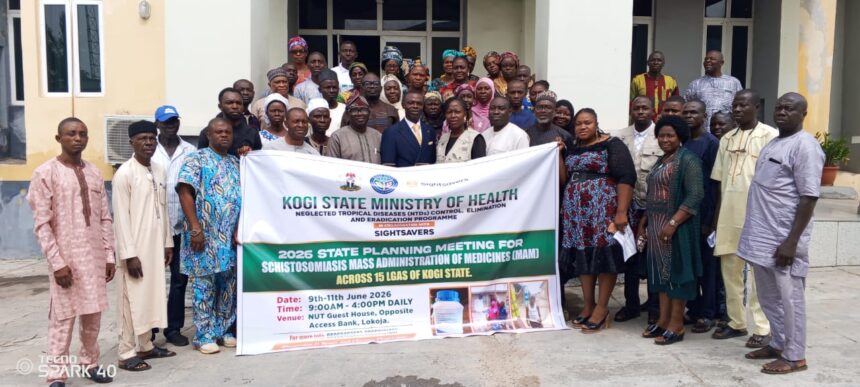
In line with this, the stakeholders converged on Lokoja for a three-day state-level planning meeting ahead of the 2026 Schistosomiasis MAM campaign.
The meeting brought together health officials, education stakeholders, development partners, and local government representatives to finalise plans for the annual drug distribution exercise aimed at eliminating schistosomiasis, also known as bilharzia.
Related News
Representing the Commissioner for Health, Dr Abdulazeez Adams, the Permanent Secretary of the Ministry of Health, Mr Maji Enoch, described schistosomiasis as a major public health concern in Kogi State, particularly among school-age children, farmers, fishermen, and communities living near freshwater bodies.
“Schistosomiasis remains a disease of public health significance in our state. The burden reduces school attendance, affects productivity, and impacts overall health outcomes,” he said.
Enoch noted that the Federal Ministry of Health, through the Neglected Tropical Diseases Programme, has prioritised preventive chemotherapy using Praziquantel as the primary strategy for controlling and eliminating the disease.
He explained that the meeting was designed to review the performance of previous campaigns, validate target populations and drug requirements, strengthen micro-planning and social mobilisation, and finalise implementation and supervision plans ahead of the June exercise.
Enoch commended Sightsavers and the Federal Ministry of Health for their technical and financial support and applauded local government authorities for their commitment to NTD elimination.
Without strong state-LGA collaboration, we cannot reach the last child in the last community, he said, urging participants to prioritise data quality, equitable drug distribution, beneficiary safety, and effective community engagement.
The National Programme Manager for the Elimination of Schistosomiasis and Soil-Transmitted Helminthiasis at the Federal Ministry of Health, Dr Jacob Solomon, said the annual exercise forms part of Nigeria’s drive to meet the World Health Organisation’s target of eliminating the disease by 2030.
“WHO has marked these diseases for elimination by 2030, and every country is working towards meeting that target. Kogi State has consistently conducted annual mass administration of medicines, and this meeting is to plan and train participants who will be involved in distributing the medicines at community and school levels,” Solomon said.
He commended Kogi State for its progress, noting that the state has successfully implemented multiple rounds of treatment since baseline disease mapping was conducted.
Kogi State has made significant progress towards elimination targets. We hope that in the coming years, impact assessments will show a reduction in endemicity and confirm that we are meeting WHO targets, he added.
Solomon called on participants to remain diligent and committed to reaching every eligible child, stressing that children between the ages of five and 14 years, whether enrolled in school or not, remain the primary beneficiaries of the programme.
The Kogi State NTD Coordinator, Mr Musa Momohjimoh, disclosed that surveys conducted in 2015 identified the 15 LGAs as endemic for schistosomiasis, leading to years of preventive chemotherapy interventions. The 2026 exercise will cover 37 wards across those LGAs, following more recent assessments that identified communities most in need of treatment.
We are targeting both public and private school pupils, as well as out-of-school children. Community Drug Distributors will move from house to house and to places where children gather to ensure no eligible child is left out, Momohjimoh said.
He added that extensive sensitisation activities, including radio jingles and community mobilisation campaigns, have already commenced across the state, and reassured parents that Praziquantel has been administered safely in Kogi State for over a decade.
“If schistosomiasis is not treated, it can eventually damage the kidneys and lead to serious health complications. This free intervention can prevent those outcomes, and we encourage parents to allow their children to participate,” he said.
The Programme Officer for Sightsavers, Mrs Phoebe Hindan, said the planning meeting aligns with the latest schistosomiasis control strategy and ensures that treatment reaches communities with the greatest need.
The fact that treatment is coming to a particular community means there is a need for it. We encourage all eligible children between the ages of five and 14 to participate because Praziquantel is safe and highly effective in controlling schistosomiasis, Hindan said.
She urged parents to disregard misconceptions about the medicine and ensure their children receive treatment.
“Some parents have refused treatment for their children in the past. We want to reassure them that the medicine is safe, effective, and administered by trained personnel under the supervision of the Ministry of Health”, she said.
Hindan reaffirmed Sightsavers’ commitment to supporting the Kogi State Government and Nigeria in eliminating neglected tropical diseases.
The meeting is expected to produce a comprehensive implementation plan to guide the rollout of the campaign across the 15 endemic LGAs.