From Joseph Adahnu, Yola
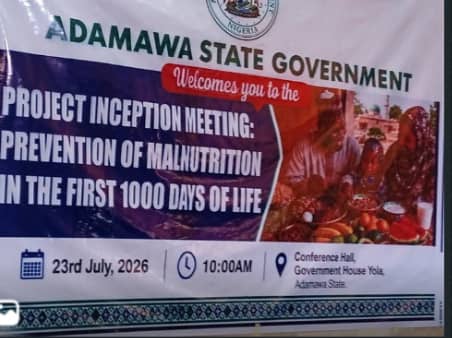
In an effort to secure a healthier future for its youngest citizens, the Adamawa State Government recently launched the First 1,000 Days of Life Nutrition Project.
The initiative, unveiled at the Government House Conference Hall, aims to provide critical nutritional support to pregnant women, newborns, and young children, during the vital window from pregnancy through a child’s second birthday.
It represents a collaborative effort involving the Adamawa State Government, UNICEF, the Church of Jesus Christ of Latter-day Saints, and other partners.
The Deputy Governor Professor Kaletapwa George Farauta, who was represented by Chief of Staff, Edgar Amos, described the project as a significant milestone in protecting children’s long-term development.
Related News
He emphasised that the first 1,000 days, form the foundation for physical growth, cognitive ability, and lifelong health, making timely nutrition interventions essential.
Amos highlighted the persistent challenge of malnutrition in Nigeria, which contributes to nearly half of all under-five deaths. In Adamawa State specifically, stunting affects 48.6 percent of children, according to the latest Nigeria Demographic and Health Survey (2023–2024) — a statistic he called deeply concerning and requiring immediate, collective response.
“The launch of this project underscores our commitment to enhancing maternal and child nutrition,” Amos stated. “Focusing on the first 1,000 days offers one of the smartest investments we can make to cut child mortality, boost learning outcomes, and create a stronger, more productive population.”
The project will be executed through the Adamawa State Primary Health Care Development Agency, in partnership with UNICEF. Funding comes from the Church of Jesus Christ of Latter-day Saints.
Key components include strengthening nutrition services, promoting better infant and young child feeding practices, community mobilization, and building the capacity of local health workers.
It also aligns with national efforts such as the Nutrition 774 Initiative and the Health Sector-Wide Approach, while supporting Governor Ahmadu Umaru Fintiri’s goal of achieving Universal Health Coverage for women and children.
Amos praised the development partners for their support and urged traditional leaders, religious figures, local governments, health workers, and communities to fully back the programme for maximum impact.
The State Commissioner for Health and Human Development, Muhammad Jada, who was represented by Permanent Secretary, Pharmacist Mathias Bubal, called the launch a timely and strategic move. He noted that better nutrition in pregnancy and early childhood is both a health necessity and an investment in the state’s human capital, as well-nourished children tend to excel academically and contribute more effectively to society.
UNICEF Bauchi Field Office representative, Huzhat Rafique, explained that the Church of Jesus Christ of Latter-day Saints is supporting the effort to tackle one of Nigeria’s major public health issues. She pointed out that 40 to 50 percent of children across various parts of the country experience malnutrition, underscoring the importance of preventive actions during the critical first 1,000 days.
The project will promote key practices including healthy pregnancies, skilled deliveries, early initiation of breastfeeding, full immunization, hygiene and sanitation improvements, exclusive breastfeeding, and appropriate complementary feeding.