By Abdulkarim Abdulmalik
In international politics, nations often find themselves balancing economic interests against moral convictions. History has repeatedly shown that this balance is rarely easy. Yet, from time to time, a government chooses a path that suggests some principles cannot be negotiated, regardless of the cost.
Recent reports that U.S. President Donald Trump, warned Spain to align more closely with Israel or risk facing trade consequences have once again brought this age-old dilemma into sharp focus. Whether viewed as a diplomatic warning, a negotiating tactic, or economic pressure, the reported message carried an unmistakable implication: political choices could have commercial consequences.
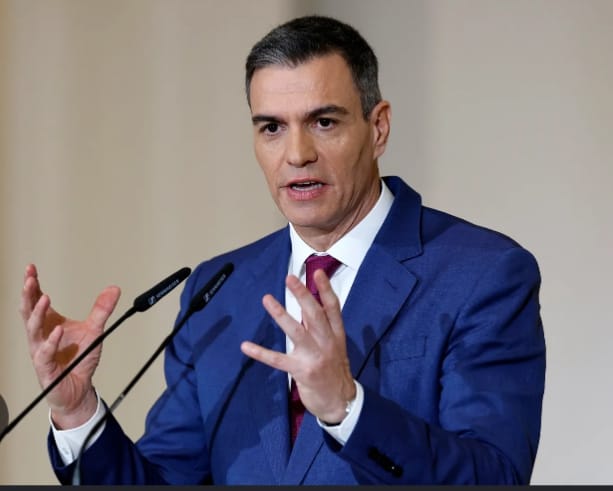
Spain’s response, led by Prime Minister Pedro Sánchez, has attracted global attention. Rather than retreating under the weight of possible economic repercussions, the Spanish government reaffirmed its position that humanitarian concerns should not be subordinated to economic calculations. In effect, Spain’s message was equally clear: human lives are not bargaining chips, and national conscience cannot be purchased through trade incentives.
This development reflects a broader question confronting governments around the world: Should economic interests determine foreign policy when humanitarian crises are involved?
Related News

For Spain, the answer appears to be no.
The humanitarian catastrophe in Gaza has generated widespread concern across continents. Thousands of civilians have been caught in the devastating consequences of prolonged conflict. Images of destroyed homes, displaced families, overcrowded hospitals, and grieving parents have stirred public opinion across Europe, Africa, Asia, and Latin America. While governments differ on political solutions, many agree that civilian protection must remain paramount.
Spain has consistently argued that concern for Palestinian civilians does not necessarily equate to hostility toward Israel. Rather, it reflects a commitment to international humanitarian law and the universal principle that innocent human life deserves protection regardless of nationality, ethnicity, or religion.
Such a position is neither simple nor politically convenient.
The United States remains one of Spain’s important economic and strategic partners. Bilateral trade, investment, defence cooperation, and diplomatic collaboration have benefited both countries for decades. Any suggestion of trade retaliation therefore carries genuine economic implications.
Yet diplomacy has never been solely about commerce.
Throughout history, nations have occasionally accepted economic discomfort in defence of values they considered fundamental. The global struggle against apartheid in South Africa required many countries to endure economic sacrifices. Sanctions imposed against oppressive regimes have often involved significant commercial losses for those enforcing them. Likewise, numerous governments have accepted political costs to defend human rights, democracy, or international law.
Spain’s current posture appears to place it within that tradition.
Supporters of Madrid’s approach argue that silence during humanitarian crises weakens the credibility of international institutions. They contend that if economic pressure can determine whether governments speak against civilian suffering, then moral leadership becomes little more than a commodity available to the highest bidder.
Critics, however, argue that foreign policy should prioritize national economic interests and strategic alliances. They caution that confrontational diplomacy could damage Spain’s economy, reduce investment, and complicate relations with one of its closest allies.
Both perspectives deserve careful consideration.
Governments bear responsibility not only for defending ethical principles but also for protecting the livelihoods of their citizens. Economic growth creates jobs, funds healthcare, supports education, and improves living standards. No responsible administration can dismiss these realities.
At the same time, there are moments when leadership requires decisions extending beyond immediate financial calculations.
Political courage is often measured not by the popularity of a decision but by the willingness to uphold convictions when doing so carries tangible costs.
This is perhaps why Spain’s response has resonated with many observers around the world.
Its position reminds the international community that diplomacy is ultimately about more than trade agreements, tariffs, or strategic partnerships. It is also about defining what values nations are prepared to defend when confronted with difficult choices.
The episode also illustrates the changing nature of global politics. Increasingly, middle powers are demonstrating greater independence in foreign policy rather than automatically aligning with larger geopolitical actors. This growing strategic autonomy reflects an evolving multipolar world where countries seek to balance partnerships while preserving independent decision-making.
Whether this trend strengthens or weakens international cooperation remains open to debate. Nevertheless, it signals that many governments wish to make foreign policy decisions based not solely on alliance expectations but also on domestic values, international law, and humanitarian considerations.
For Africa and other regions of the Global South, Spain’s position also raises important questions. Many developing countries have long argued that international responses to humanitarian crises should be guided by consistent standards rather than geopolitical interests. They have frequently called for equal concern for all civilian populations regardless of where conflicts occur.
Consistency remains one of the greatest challenges facing international diplomacy.
If civilian lives deserve protection in one conflict, they deserve equal protection in every conflict. Human dignity should not depend upon geography, political alliances, or economic leverage.
Ultimately, history often judges nations less by their economic strength than by the principles they defend during periods of crisis. Trade agreements may expire. Political administrations may change. Economic disputes may eventually be resolved.
But moral choices frequently leave lasting legacies.
Whether one fully agrees with Spain’s policy or not, its response has reignited an important global conversation about the relationship between power and principle. It challenges governments everywhere to reflect upon the values that shape their foreign policy decisions and the price they are willing to pay to uphold them.
In a world increasingly driven by strategic competition and economic influence, Spain’s reported response serves as a reminder that there are moments when conscience seeks to speak louder than commerce.
History has often remembered those who chose humanity over convenience. The present generation now watches to see which path today’s leaders will choose.
– Abdulkarim Abdulmalik, an Abuja-based Journalist, can be reached on: nowmalik@gmail.com