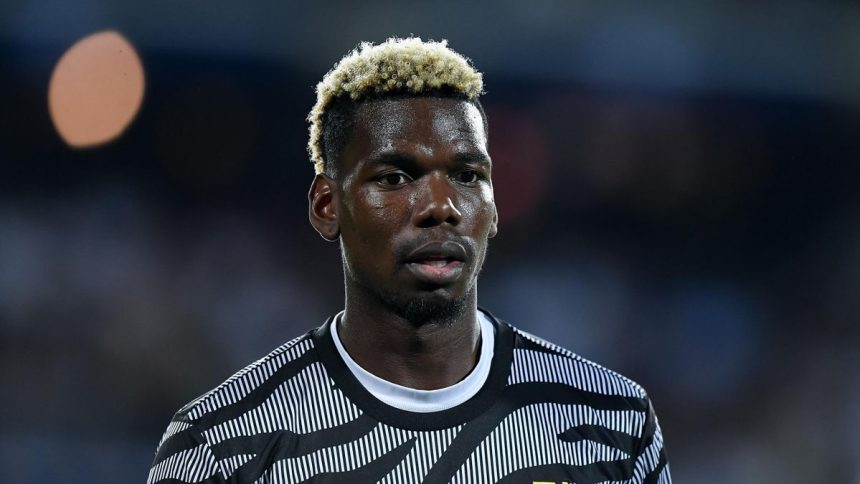
Paul Pogba has been suspended from football for four years after a failed anti-doping test.
Juventus midfielder Pogba, 30, believes the verdict is “incorrect” and will appeal against it at the Court of Arbitration for Sport (CAS).
Pogba was initially handed a provisional suspension by NADO Italia (the Italian Anti-Doping Organisation) in September after the failed test, which followed his side’s 3-0 win at Udinese on August 20.
FIFA’s guidelines for suspensions on players who violate its anti-doping regulations ranges between two and four years, depending on whether it can be proven that the rule violation was intentional.
“I have today been informed of the Tribunale Nazionale Antidoping’s decision and believe that the verdict is incorrect,” Pogba said in a statement.
Related News

“I am sad, shocked and heartbroken that everything I have built in my professional playing career has been taken away from me. When I am free of legal restrictions the full story will become clear, but I have never knowingly or deliberately taken any supplements that violate anti-doping regulations.
As a professional athlete I would never do anything to enhance my performance by using banned substances and have never disrespected or cheated fellow athletes and supporters of any of the teams I have played for, or against.
As a consequence of the decision announced today I will appeal this before the Court of Arbitration for Sport.
The France international was initially suspended in September after his test detected testosterone not produced by the body, according to NADO Italia.
NADO said that testosterone not produced by the body was detected in the ‘A sample’ Pogba provided. Following Pogba’s provisional suspension, his ‘B sample’ was sent for further tests at the Acqua Acetosa clinic in Rome, which is where the failed test was confirmed.
Pogba was an unused substitute in the match against Udinese which preceded his failed test, but he did come off the bench in the club’s subsequent two Serie A matches — a 1-1 draw at home to Bologna and a two-goal victory at Empoli.
Pogba returned to Juventus in the summer of 2022 following six years at Manchester United, but fitness issues restricted him to just 10 appearances in the 2022-23 campaign.
The most recent of the midfielder’s 91 caps for France came in March 2022, and his two substitute outings are his only two appearances of this season.
Pogba is under contract at Juventus through to the summer of 2026.
Juventus are currently second in Serie A, 12 points behind league leaders Inter, are next back in action with a league trip to Napoli on March 3.
So, does Pogba’s ban apply worldwide?
Pogba has been banned by NADO Italia, which oversees all athletes in the country and is a “functional body” of the World Anti-Doping Agency (WADA).
FIFA and NADO Italia are both signatories on WADA’s World Anti-Doping Code (WADC) — “the definitive anti-doping rulebook”. FIFA also sets its own football anti-doping rules in line with the WADC.
The WADC is a comprehensive 181-page document which outlines the anti-doping regulations but the key part of it in relation to Pogba’s ban is as follows:
“A decision… imposing a period of ineligibility (after a hearing has occurred or been waived) automatically prohibits the athlete or other person from participation in all sports within the authority of any signatory for the period of ineligibility.”
This essentially means that Pogba’s ban automatically applies to all the signatories to the WADC — which includes FIFA and almost every country’s anti-doping agency in the world. The same applies if the Court of Arbitration for Sport (CAS) upholds Pogba’s ban after appeal.
What are anti-doping rules?
Anti-doping rules exist within football to ensure nobody gains an unfair competitive advantage and to protect a player’s health. The World Anti-Doping Agency sets out a code which most sporting organisations around the world follow.
FIFA’s website says “it is the player’s strict responsibility to make sure that their body does not come into contact with any prohibited substance or method” and that they should check every medication or treatment they receive.
The World Anti-Doping Agency (WADA) has a list, which it regularly updates, of prohibited substances and methods. Athletes are only allowed to use prohibited substances or methods if they have a legitimate medical reason and are granted a therapeutic use exemption (TUE).
For example, the British cyclist Sir Bradley Wiggins was granted a TUE ahead of the 2012 Tour de France which allowed him to take the corticosteroid Triamcinolone to treat asthma — Wiggins went on to win the event. Triamcinolone was added to WADA’s prohibited list in 2014 as it also has performance-enhancing properties, namely allowing athletes to reduce their weight without suffering a significant loss in power.
How often are football players tested?
Due to the random nature of the tests, players might go through periods of their career where they are tested a lot or rarely.
During the men’s World Cup in Qatar last year, FIFA carried out 369 tests which produced 941 samples. According to official data from FIFA, every player was tested at least once in the year building up to the tournament.
Players from the eight teams which reached the quarter-finals (Morocco, England, France, Brazil, Argentina, Croatia, the Netherlands and Portugal) were tested on average 4.6 times from January 2022. Some members of those eight squads were tested up to 10 times.
What happens when a player tests positive?
If traces of a prohibited substance are found within a player’s body, they are provisionally suspended while further analysis takes place. Pogba’s ‘A’ sample flagged up traces of testosterone. The human body naturally produces testosterone but exogenous testosterone can be detected by measuring the ratio of testosterone (T) to epitestosterone (E) in an athlete’s urine.
When players provide a sample, it is split into two parts which are labelled A and B. If the A sample is positive for a banned substance, the B sample is checked as a precautionary measure, which is what happened in Pogba’s case. The player can request a B sample being tested within three days of a positive test. Once the request is made, the result of this test has to be delivered within seven days.
Conor Benn’s boxing match against Chris Eubank Jnr in October 2022 was called off two days before it was due to take place. A substance called Clomifene was found in Benn’s body. Clomifene is on WADA’s banned list because it can help raise the levels of testosterone in an athlete’s body. The decision to cancel the fight was made before Benn’s B sample was analysed.
In February 2023, the World Boxing Council issued a statement which said Benn provided an adverse analytical finding due to a “highly-elevated consumption of eggs” and that it was “a reasonable explanation.” Benn was reinstated to the WBC rankings and in July the National Anti-Doping Panel lifted his suspension.
Have similar incidents happened before in football?
During his time at Ajax, traces of Furosemide were found in Manchester United goalkeeper Andre Onana’s system.
The substance was in a pack of tablets Onana’s wife was prescribed after giving birth and the goalkeeper accidentally took them. UEFA accepted Onana’s version of events but he was still given a 12-month ban, which was reduced to nine on appeal.
In July 2022, Atalanta defender Jose Palomino tested positive for clostebol metabolites. Palomino was unable to play for three months while he waited for an outcome but was absolved in September due to accidental contamination.