By Joy Salami
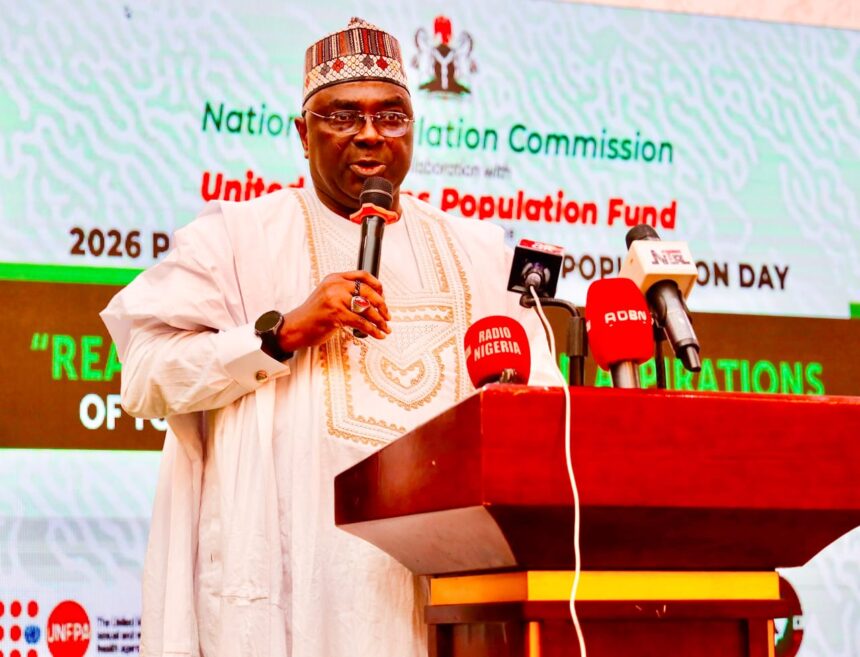
The Chairman of the National Population Commission (NPC), Dr Aminu Yusuf, has called for increased investment in Nigeria’s young population, describing them as the country’s greatest asset and key to achieving sustainable economic growth and development.
Speaking at a press briefing in Abuja ahead of the commemoration of the 2026 World Population Day (WPD), Dr Yusuf said this year’s global theme, “Realizing the hopes and aspirations of young people, today and for the future,” underscores the need for governments to move beyond merely counting young people to creating opportunities that enable them to thrive.
He said Nigeria, with an estimated population of 242 million people, remains the most populous country in Africa and one of the youngest globally, with people aged 15 to 29 accounting for about 30 per cent of the population.
According to him, the country’s demographic advantage can only translate into economic growth if young people are healthy, educated, skilled and productively engaged.
Related News

The future of every nation is shaped not merely by the size of its population, but by the opportunities available to its people, especially its young population, he said.
Dr Yusuf said the 2026 World Population Day activities would also provide an opportunity to share findings from the United Nations Population Fund (UNFPA) Global Demographic Future Survey and assess Nigeria’s progress in youth development under President Bola Ahmed Tinubu’s Renewed Hope Agenda.
Reviewing key youth development indicators, the NPC chairman noted that youth unemployment remained around 33 per cent, while underemployment exceeded 20 per cent, attributing the situation largely to the mismatch between educational curricula and labour market demands. He added that about 80 per cent of employed young Nigerians work in the informal sector.
On health, he said Nigeria’s Total Fertility Rate had declined from 5.3 to 4.8 children per woman, although adolescent fertility remained high at 15 per cent due to limited access to comprehensive reproductive health services and other structural challenges.
He also expressed concern that Nigeria still accounts for nearly 20 per cent of the global out-of-school children population despite interventions by federal and state governments.
Highlighting ongoing government initiatives, Dr Yusuf said the administration had repositioned youth development through programmes such as the Three Million Technical Talent (3MTT) initiative, which has certified 30,000 fellows across the 36 states and the Federal Capital Territory in its first phase.
He said the Nigerian Education Loan Fund (NELFUND) had also been established to improve access to higher education through student loans, while more than 150,000 young Nigerians are currently enrolled in tuition-free vocational training programmes across 1,600 accredited centres nationwide.
The NPC chairman further disclosed that the commission was strengthening the country’s Civil Registration and Vital Statistics (CRVS) system and National Geospatial Data Repository to improve digital birth registration and demographic data collection across the 774 local government areas.
Despite the progress, he identified infrastructure deficits, rising living costs, insecurity and implementation gaps as major obstacles limiting the impact of youth-focused programmes.
He therefore called for an accelerated review of the National Youth Policy and reiterated the commission’s demand for a credible, technology-driven Population and Housing Census.
“We cannot plan for a population we do not accurately count,” he said, stressing that an accurate census remains essential for evidence-based planning and equitable resource allocation.
Dr Yusuf also lamented the slow implementation of demographic dividend programmes across the country, noting that only seven states and the Federal Capital Territory currently have roadmaps to harness the economic benefits of Nigeria’s youthful population.
He urged governments at all levels, development partners and other stakeholders to make deliberate investments in education, healthcare, skills development, employment and reproductive health services to enable young people realise their full potential.
The NPC chairman commended the UNFPA and other development partners for supporting Nigeria’s population and development agenda and acknowledged the media’s role in promoting public awareness on population issues.
He announced that activities lined up for the 2026 World Population Day include media engagements, youth-centred advocacy programmes, public awareness campaigns and stakeholder consultations aimed at amplifying the voices of young people and promoting evidence-based development planning.