By David Onuoja
Lagos State Government and Julius Berger PLC, has synergized a joint roadmap to grow Africa’s second-largest city economy into a trillion-dollar powerhouse by 2052 with Infrastructure, investment and long-term planning.
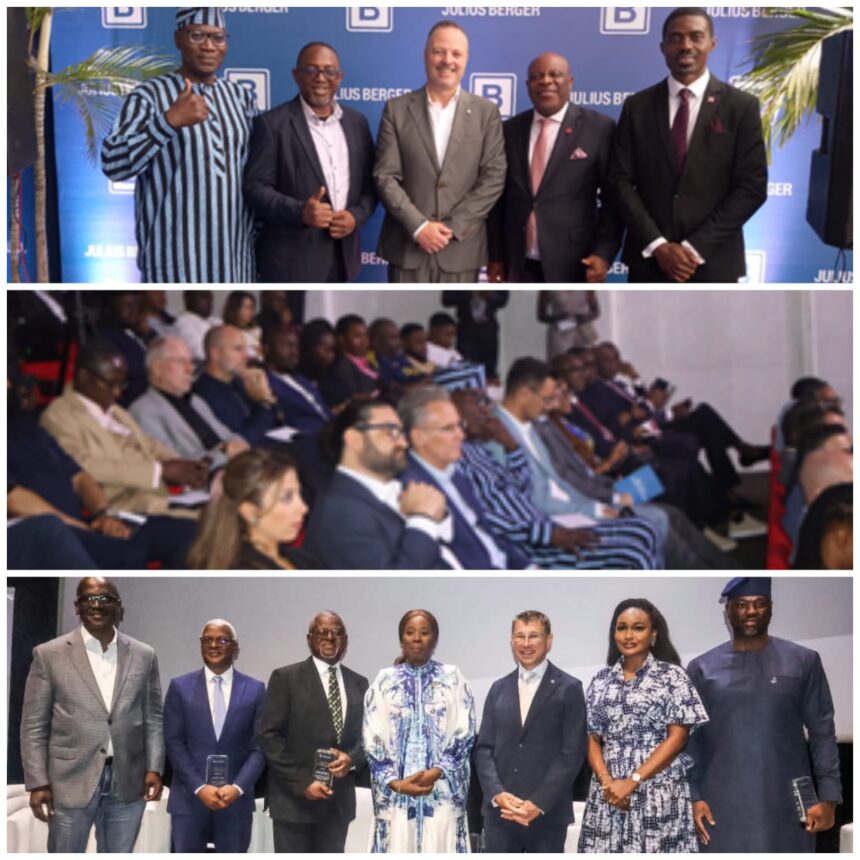
The event was held at the Alliance Française de Lagos, Mike Adenuga Centre in Ikoyi. The annual gathering brought together developers, architects, financiers, policymakers and business leaders under the theme “The Lagos Proposition: Unlocking value in a city in transformation”.
Earlier in his opening address, the Managing Director of Julius Berger Nigeria Plc, Engr. Peer Lubasch, said the forum was designed to drive meaningful dialogue on Nigeria’s economic future and built environment.
He described the theme as a call to action, noting that turning potential into value requires deliberate strategy and execution. “Potential alone does not build a city; execution does,” Lubasch said, adding that Lagos’ growth is now spreading beyond traditional commercial hubs to the Lekki-Epe corridor, the Lagos-Ibadan axis and other emerging locations.
Related News
Lubasch challenged the focus on upfront project costs, arguing that asset value should be measured over its lifetime. Drawing on Julius Berger’s more than 60 years in Nigeria, he said the company’s integrated model, spanning engineering, procurement, manufacturing and facility management, allows it to deliver and maintain infrastructure from conception to operation.
“Our philosophy is not to optimise for the day of handover but to optimise for the lifetime of the asset,” he said, noting that quality engineering reduces maintenance costs and preserves value.
Delivering a keynote address, Lagos State Commissioner for Commerce, Cooperatives, Trade and Investment, who represent the state government, Mrs Folashade Ambrose-Medebem, described Julius Berger as a natural partner in the state’s transformation agenda.
She said transformation happens at the intersection of vision, leadership, infrastructure, investment and execution. Ambrose-Medebem also disclosed that Lagos’ GDP stands at about $260 billion on a purchasing power parity basis, making it Africa’s second-largest city economy and accounting for over 30 percent of Nigeria’s output.
The commissioner anchored the state’s ambitions on the Lagos State Development Plan 2052, a 30-year strategy with 447 initiatives across 21 sectors aimed at building an $800 billion to $1 trillion economy. She added that the Lagos State Industrial Policy 2025-2030 will strengthen manufacturing and small businesses.
To support that growth, Lagos attracted N50 billion in investments in the past year and allocated N1.467 trillion to infrastructure in the 2026 budget. Key projects cited include the Lekki Deep Sea Port, Lagos Free Zone, and the Blue and Red Rail Lines.
Housing and private sector collaboration also dominated discussions. Ambrose-Medebem equally said Lagos faces a deficit of about 3.4 million housing units and needs more than 227,000 new homes annually, requiring roughly N6 trillion in yearly investment. “No government anywhere in the world can solve a six-trillion-naira annual housing challenge alone,” she said, calling for co-created solutions with the private sector. While pointing out that the new investments such as Twinings Ovaltine Nigeria’s first African production facility in Lagos as proof of growing investor confidence.
The discussion focused on infrastructure delivery, industrialisation and financing, and reinforced the event’s central message. As leaders agreed, Lagos’ future value will be determined not just by ambition, but by the quality of partnerships and the discipline to execute projects that stand the test of time.