From Taiye Joseph, Ilorin
Nigerian universities must move beyond merely surviving persistent challenges and begin building institutions capable of anticipating disruption, embracing artificial intelligence and driving national development, the Committee of Vice-Chancellors of Nigerian Universities (CVCNU) has said.
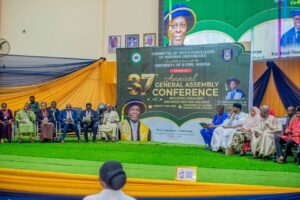
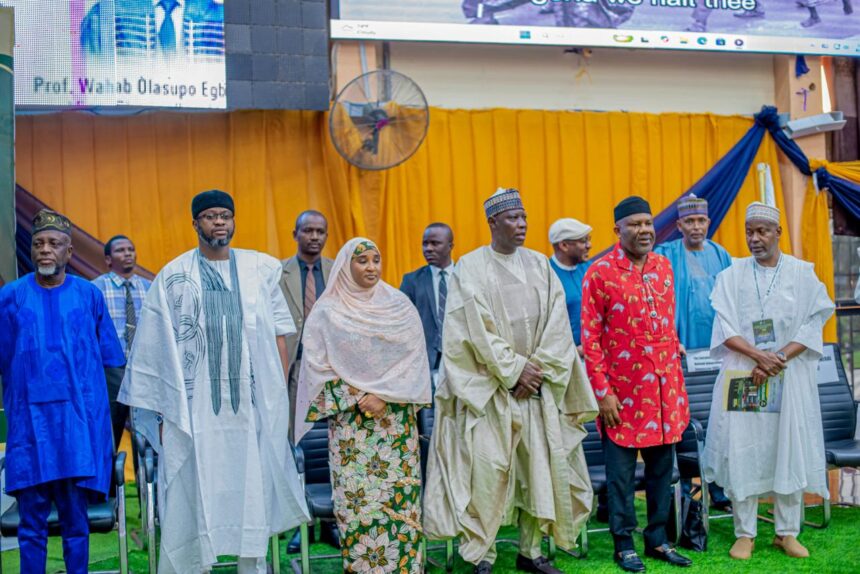
The call was made in Ilorin, Kwara State, at the 37th Annual General Assembly and Conference of the CVCNU, hosted by the University of Ilorin and themed “Building Resilient Universities for Nigeria.”
Chairman of the CVCNU and Vice-Chancellor of Igbinedion University, Okada, Professor Lawrence Ezemonye, said the Nigerian university system was facing a critical test of relevance as the country grappled with technological disruption, funding challenges, demographic pressures, industrial disputes and the migration of skilled academics.
Related News


Ezemonye said universities had survived several crises in the past, but the current challenge was to remain relevant to a young population with increasingly high expectations.
“We meet at an hour when the Nigerian university is being tested as it has seldom been tested since the years immediately after independence. The test is not of our survival, for we have survived much. It is of our relevance to a young, restless and expectant nation,” he said.
He identified governance and institutional autonomy, financial sustainability, the development of AI-ready universities, stronger partnerships among universities and other stakeholders, as well as human capital development and staff and student welfare as critical pillars for building resilient institutions.
The CVCNU chairman also urged vice-chancellors and other stakeholders to confront the weaknesses within the university system frankly and develop recommendations that could be implemented rather than allowing conference resolutions to remain on paper.
“The challenges before us are too grave and too urgent to be obscured by politeness or deference. We must speak plainly about the failures of the past and the demands of the future,” he said.
Delivering the keynote address, former Vice-Chancellor of the University of Ilorin and former Registrar of the Joint Admissions and Matriculation Board (JAMB), Prof. Is-haq Oloyede, said resilience should not be interpreted as the ability of universities to endure recurring problems indefinitely.
Speaking on “Reimaging Nigerian Universities for Resilience: Leadership, Innovation and Sustainability in a Disruptive Era,” Oloyede said resilience meant anticipating risks, adapting intelligently and deliberately transforming institutions.
“Resilience is therefore not stubborn endurance. It is structured adaptation and disciplined renewal,” he said.
He described leadership as “the first infrastructure of resilience,” warning that no amount of infrastructure or technology could compensate for weak governance, poor judgement and impunity.
Oloyede urged universities to ensure that strategic plans were linked to budgets, appointments, infrastructure, partnerships and performance evaluation, rather than being treated as ceremonial documents.
He also called for deliberate leadership development and succession planning, saying university administrators required skills in budgeting, conflict resolution, data governance, risk management and institutional transformation in addition to academic excellence.
On technology, the former JAMB Registrar warned universities against mistaking digitisation for transformation. “We cannot digitise disorder and call it transformation,” he declared.
He urged universities to reform curricula to equip graduates with digital competence, data literacy, communication, entrepreneurship, problem-solving, teamwork and lifelong learning skills while maintaining strong disciplinary foundations.
Oloyede said the rapid emergence of generative artificial intelligence had made it necessary for universities to rethink teaching and assessment rather than simply ban technologies students could access outside the classroom.
He called on every university to develop an institution-wide AI policy covering teaching, research and administration, including responsible use, disclosure, data protection, academic integrity and staff development.
“In the age of generative artificial intelligence, universities cannot protect academic integrity simply by banning tools that students can access outside the classroom,” he said.
He advocated assessment systems that test students’ reasoning, creativity, application, evidence and ethical judgement.
Beyond teaching, Oloyede called for research to be more directly connected to Nigeria’s development needs, urging universities to establish interdisciplinary research clusters around food security, healthcare, energy, climate adaptation, education, governance, conflict prevention, manufacturing and digital inclusion.
He said universities should move away from a system where research was pursued largely for promotion purposes to one where scholarship also addressed national and regional challenges.
On funding, Oloyede advocated predictable government investment combined with transparent revenue diversification through endowments, alumni support, competitive grants, executive education, professional programmes, consultancy, intellectual property and research partnerships.
“The most valuable source of sustainable support is trust. Alumni and partners give more readily to institutions that explain their priorities, publish audited accounts, demonstrate results and recognise contributors,” he said.
He also called for stronger measures to prevent students from disadvantaged backgrounds from being excluded by rising educational costs, commending the Federal Government’s attention to the Nigerian Education Loan Fund as an important tool for promoting educational equity.
Oloyede further raised concern over the migration of skilled academics and urged universities to improve working conditions, research support, mentoring and professional development while establishing stronger links with Nigerian academics in the diaspora.
He proposed visiting appointments, joint research, postgraduate co-supervision, shared laboratories, short courses and virtual academic programmes as ways of deepening diaspora engagement.
The former University of Ilorin vice-chancellor also urged universities to treat staff and student welfare as an integral part of academic quality, noting that insecurity, financial difficulties, harassment and discrimination could negatively affect learning and productivity.
He called for environmentally sustainable campuses that could serve as laboratories for renewable energy, water conservation, waste management and climate adaptation.
Oloyede also urged universities to develop distinctive identities instead of attempting to offer every programme.
“Not every university must be everything to everyone. Institutions should define areas of distinctive strength based on mandate, location, staff capacity, infrastructure and national need,” he said.
He advocated greater collaboration among universities through shared laboratories, joint doctoral programmes, reciprocal library access, coordinated research, joint procurement, staff exchanges and shared digital resources.
He commended the University of Ilorin for its leadership of the Consortium of Universities in Kwara State, describing it as a model of inter-university cooperation capable of reducing duplication and strengthening the university system.
Oloyede proposed a Nigerian Universities Resilience Compact through the CVCNU, with measurable commitments, peer review and annual reporting. He said the compact should cover institutional integrity, strategic governance, student success, curriculum relevance, responsible digital transformation, research for public value, sustainable finance, human capital development, climate-smart campuses and inter-university collaboration.
He also called on the Federal Government to provide predictable funding and a stable policy environment while respecting institutional autonomy, and urged the National Universities Commission (NUC) to adopt more risk-based and outcome-oriented quality assurance mechanisms.
Oloyede challenged industry to increase investment in universities through joint research, endowed chairs, internships, laboratories and staff exchanges, while urging alumni to remain active partners in institutional development.
He also called for structured dialogue between government and university unions to reduce recurring industrial disputes.
“The new image of the Nigerian university will not be produced by mere slogans or public relations. It will be made credible by choices repeated until they become culture,” he said.
Meanwhile, the Executive Secretary of the National Universities Commission ( NUC), Prof. Abdullahi Ribadu, warned universities against violating new regulatory guidelines, particularly those governing honorary doctorate degrees.
Ribadu said universities must comply with regulations on convocations and honorary degrees, stressing that honorary doctorates should not be conferred on individuals who do not meet the stipulated requirements.
He also said serving public office holders should not be recipients of such honours under the new guidelines.
“It has been bastardised in the past. So, for now, we say, please, you are doing well. When you leave office, the university will honour you,” Ribadu said.
In a related development, Chairman of the Committee of Pro-Chancellors of Nigerian Federal Universities, Prof. Ahmed Yayale Ahmed, urged vice-chancellors and governing councils to end rivalry and embrace partnership in managing universities.
Ahmed said the challenges confronting higher education required trust, transparency and a shared sense of purpose between university management and governing councils.
“Governing Councils are supervisory and advisory organs constituted by Government to support good governance and ensure the smooth and effective running of our institutions,” he said.
The Kwara State Government also called for stronger investment across the education chain, saying resilient universities could only be built on strong foundations at the basic and secondary levels.
The state governor, Mallam AbdulRahman AbdulRazaq, represented by the Commissioner for Education and Human Capital Development, Dr Lawal Olalekan Olohungbebe, said tertiary education remained a major priority of the administration.)
Olohungbebe said the state was investing not only in tertiary education but also in foundational education to ensure that students were adequately prepared before entering universities.
“On behalf of the state government, we understand how important tertiary education is, and we continue to invest heavily, not only in tertiary education, but we will start from the bottom,” he said.
He highlighted community development, service learning and local impact with international relevance as important components of a resilient university system.
The commissioner also cited KwaraLEARN as an initiative through which the state monitors teachers’ attendance and classroom activities in basic schools.
“With KwaraLEARN, we are able to supervise every teacher in the class, who is in the class and who is not in the class. And not just being in the class; what are you doing in the class?” he said.
Olohungbebe urged the conference participants to ensure that their deliberations produced practical reforms rather than recommendations that would remain on shelves.
“We look forward to having a fruitful celebration, and not just the ones that will end up on the shelves, but the ones that will end up in our programmes, making local impact and international relevance,” he said.
The four-day CVCNU conference, which began on August 17 and ends on August 20, has brought together vice-chancellors, academics, regulators, government representatives and other stakeholders to examine strategies for making Nigerian universities more resilient, innovative and globally competitive.
For Oloyede, however, the ultimate test of the conference will be whether university leaders return to their institutions with concrete action plans.
He urged universities to identify their most serious vulnerabilities, establish priorities, assign responsibilities, commit resources and set measurable targets within 90 days.
“The challenge before us is formidable, but it is not beyond us. Nigerian universities contain the knowledge, experience and human courage required for renewal. What we need is the discipline to act together and the integrity to sustain the action,” he said.