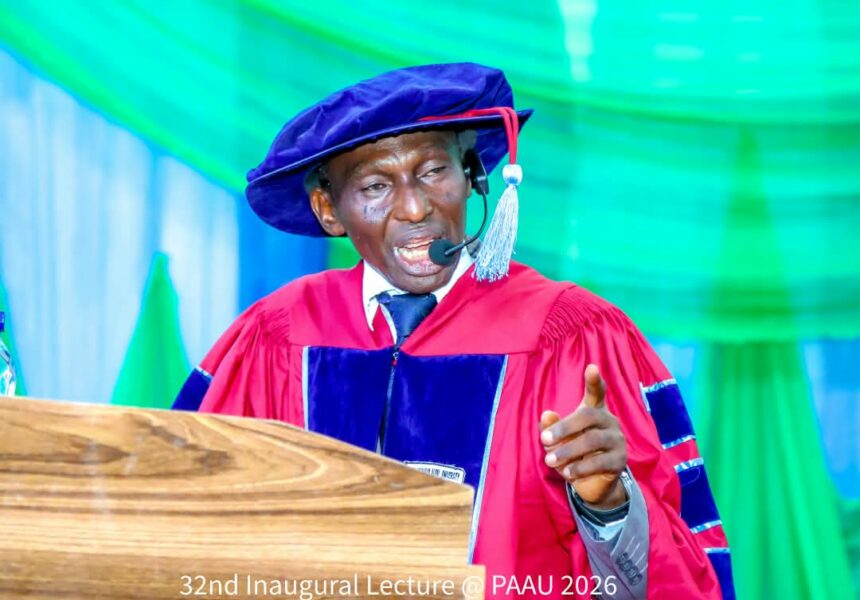
By Our Reporter
Prince Abubakar Audu University (PAAU), Anyigba, held its 32nd Inaugural Lecture, with Professor Joseph Odoba Achegbulu calling for national ethical reorientation and comprehensive bureaucratic reforms to strengthen public administration and promote good governance in Nigeria.
Prof. Achegbulu, a Professor of Human Resource Management and Development, delivered the lecture titled, “Nigerian Public Bureaucracy: A Casualty of Ecological Outreach?”
It was the first inaugural lecture in the Department of Public Administration and the fifth in the Faculty of Management Sciences.
He described public bureaucracy as “government in action” and the hub through which government policies and programmes are translated into tangible outcomes that affect citizens’ quality of life.
Related News

According to him, the efficiency, effectiveness and character of a country’s public bureaucracy are strongly linked to its level of development.
A weak and ineffective bureaucracy, he warned, can contribute to poverty, unemployment, inequality, low foreign direct investment, youth restiveness, high infant mortality, brain drain, ethno-religious crises and other centrifugal tendencies.
Prof. Achegbulu lamented that the Nigerian public bureaucracy has increasingly become associated with red-tapism, tardiness, bottlenecks, inertia, ineffectiveness and inefficiency, despite its critical responsibility for implementing government policies and programmes.
He explained that the classical Weberian model of bureaucracy rests on hierarchy of offices, division of labour, legal-rational authority, impersonality, appointment based on qualifications, professionalism and political neutrality.
These principles, he said, are designed to promote efficiency, continuity, discipline and predictable administrative processes.
He listed accountability, transparency, impartiality, integrity, loyalty and professionalism as core values required for an effective public service, adding that public officers must place public interest above personal considerations and demonstrate honesty, discipline, courage, courtesy, cooperation, diligence and respect for rules and regulations.
Reviewing historical reform efforts, he cited the Harragin Commission, the Sir Hugh Foot Commission, the Phillipson-Adebo Commission, the Gorsuch Commission, the Udoji Reforms, the 1988 Civil Service Reforms and the Allison Ayida Review Panel of 1994.
Despite those efforts, he observed, challenges relating to inefficiency, politicisation, corruption, weakened accountability and conflicts within the administrative structure have continued to affect the performance of the public service.
Prof. Achegbulu identified several ecological pathologies confronting the Nigerian public bureaucracy.
These include competition for the national cake, manifested in persistent demands for more states, local government areas and government structures; administrative overreach by top bureaucrats; corruption and collusion between bureaucrats and politicians; and conflictual relationships between generalists and professionals.
Others are politicisation of appointments, preference for patronage and primordial considerations over competence, acrimonious relationships between special advisers and political office holders, indiscipline, godfatherism and poor remuneration, which has weakened the purchasing power and morale of public servants.
Drawing on Institutional Theory, he argued that the resilience and effectiveness of public institutions depend on adherence to constitutional provisions, statutory rules, professional norms and established procedures.
He cautioned that weak institutional structures create room for political interference and institutional capture, thereby undermining the bureaucracy’s capacity to discharge its responsibilities effectively.
He emphasised that sustainability of public institutions requires conscious commitment to institutional rules, ethical values, professional standards and the integrity of established administrative processes.
He also called for a constructive relationship between political office holders and career bureaucrats.
To address the challenges, Prof. Achegbulu advocated a comprehensive national ethical reorientation and character reformation programme.
He called for the establishment and enforcement of a code of conduct for the political class, with appropriate sanctions for violations.
He recommended that political appointments be based on merit, equity, competence and relevant professional expertise, rather than partisan patronage or primordial considerations. Bureaucrats, he said, should be insulated from undue partisan political interference to enable them to discharge their duties with professionalism, impartiality and accountability.
He further urged professional associations to strengthen ethical standards through ethics committees and enforcement of professional discipline.
He stressed the need to build strong institutions, promote transparency and accountability, and ensure that public officers are guided by public interest and responsible leadership.
Revitalising the Nigerian public bureaucracy, he maintained, will require commitment from both political leaders and public servants, as well as conducive working conditions and renewed emphasis on competence, experience, creativity and professionalism.
Earlier, the Chairman of the Inaugural Lecture Committee, Prof. S. S. Arogba, congratulated the inaugural lecturer on the academic milestone.
In his address, the Vice-Chancellor, Professor Salisu Ogbo Usman, described the subject as timely and consequential, noting that public bureaucracy remains the machinery through which government policies are translated into services that shape citizens’ everyday lives.
Prof. Usman observed that political, economic, social, cultural and technological forces influence the structure, personnel management, decision-making and service delivery of public institutions.
Political interference, patronage, ethnic and religious considerations, economic constraints and informal expectations, he said, could weaken merit, neutrality, professionalism and accountability.
He, however, cautioned against attributing every institutional weakness solely to external pressures, pointing out that leadership quality, internal management practices, workforce capacity, institutional discipline and enforcement of standards also matter.
He congratulated Prof. Achegbulu on the milestone and acknowledged his contributions to Human Resource Management and Development.
He also commended the Chairman and members of the Inaugural Lecture Committee for the successful organisation of the event.
The lecture attracted members of the University Governing Council, the University community, traditional and religious leaders and other invited guests.