Taiye Joseph, Ilorin
What began as a routine evening in the agrarian settlements of Woro and Nuku in Kaiama Local Government Area, quickly descended into one of the deadliest attacks to hit Kwara’s northern corridor in recent years, exposing the fragility of communities straddling the Kainji forest axis.
Residents say the gunmen struck around 5:00 p.m., surrounding the town and opening fire from multiple directions. By the time the shooting stopped on February 3, dozens lay dead. While initial accounts mentioned about 40 casualties, community leaders insist the toll climbed far higher.
“They came around 5:00 p.m. and completely surrounded the community and started shooting sporadically from all angles, so nobody could escape,” said Umar Ali, a relative of the traditional ruler in the area. “We physically counted 75 corpses within the town.”
Beyond the numbers, the attack left deep scars. About 80 shops were reportedly razed, homes reduced to ashes, and families displaced. Survivors are receiving treatment in Ilorin and Kainji, while many residents have temporarily fled across the Niger border, unsure when it will be safe to return.
Related News
Community sources say the assailants had earlier moved through border villages preaching a rigid ideology and urging locals to abandon Nigeria’s constitutional order. Tension reportedly rose when some villagers openly rejected the message.
“There were dissenting voices during the sermon and that was when the bandits became furious. They started shooting indiscriminately,” a local source recounted. “No fewer than 40 people were killed on the spot.”
Among the victims was Salihu Bio Khalid, a midwifery student of Kwara State College of Nursing Sciences and a former student union leader. His death reverberated across campuses, with students calling for improved protection of rural communities and institutions located in volatile zones.
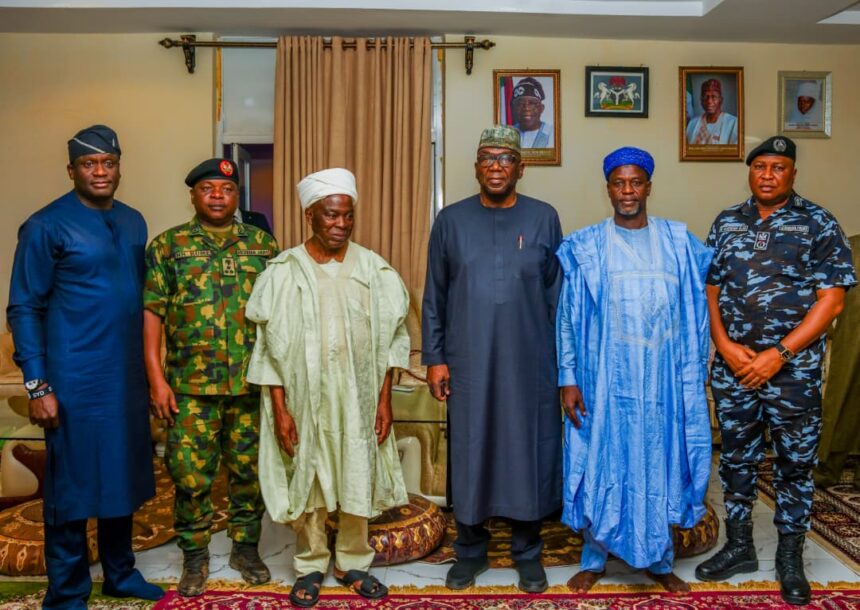
Governor AbdulRahman AbdulRazaq, described the killings as a massacre during a visit to the affected communities. He directed the State Emergency Management Agency, to enumerate victims and support bereaved families, and later set up a committee to coordinate humanitarian relief and rebuilding efforts.
“We are very sad. We are here to commiserate with the people of Kaiama over the loss of about 75 lives,” the governor said. “These people were not kidnapped for ransom; they were massacred because they refused to submit to a strange ideology. That is deeply disturbing.”
At the federal level, President Bola Tinubu ordered the deployment of a full Army battalion under Operation Savannah Shield, a joint security task force covering Kwara and parts of Niger State. He described the killings as barbaric and a doomed campaign of terror against defenceless villagers.
“The gunmen chose soft targets and unleashed violence on innocent people,” the President stated, assuring Nigerians that security agencies had been mandated to restore calm and bring the perpetrators to justice.
Vice President Kashim Shettima later led a condolence delegation to Ilorin, pledging federal support for relief and security operations and describing the incident as an unacceptable breach of peaceful coexistence.
The military high command formally flagged off Operation Savannah Shield at Sobi Barracks in Ilorin, with assurances that forest corridors around Kainji Lake and adjoining territories would be combed to flush out criminal elements suspected of using the area as transit and staging grounds.
Governor AbdulRazaq said the operation’s launch was a major relief for residents, particularly farmers whose livelihoods have been disrupted by persistent insecurity.
“These challenges go beyond national security,” he noted. “We are driving into the road of food security because the vast area this operation will cover is our farming belt.”
However, anger and frustration have also spilled onto the streets. Members of the Take It Back Movement and concerned youths from Kwara North staged a protest at the Government House in Ilorin, decrying what they described as worsening insecurity across Kaiama, Edu and Patigi local government areas.
Carrying placards with inscriptions such as “Our region is under attack. Kwara North needs protection, not abandonment,” the demonstrators accused authorities of not doing enough to stem the tide of killings and kidnappings.
“Protest is not chaos; it is a desperate call for attention to the suffering in Kwara North. Our people are living in fear daily,” one youth leader said.
Another protester declared, “The Woro massacre and Gbugbu attacks cannot be ignored. Kwara North is bleeding. The government must act now.”
They demanded reinforcement of security personnel, improved intelligence gathering and community-based strategies tailored to the terrain and peculiar challenges of border settlements.
For many observers, the tragedy marks a sobering moment for Kwara, a state long perceived as relatively insulated from the scale of insurgency witnessed in parts of the North East and North West. The Kaiama killings underscore the creeping reach of armed groups into North Central farmlands and the complex interplay of ideology, criminality and porous borders.
As mass burials were conducted according to Islamic rites, the people of Woro and Nuku were left grappling not only with grief but also with uncertainty. With troops now on patrol and relief committees at work, residents say condolences alone will not suffice.
What they seek is security that endures beyond emergency deployments, justice that deters future bloodshed, and the confidence to return to their farms, markets and mosques without fear.