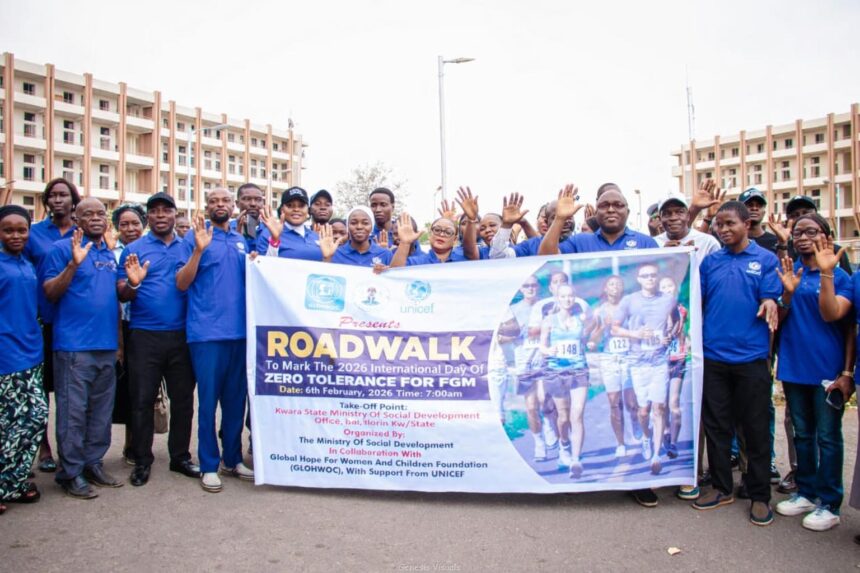
From Taiye Joseph, Ilorin
As Nigeria observed the 2026 International Day of Zero Tolerance for Female Genital Mutilation (FGM), the Global Hope for Women and Children Foundation (GLOHWOC), urged all levels of government to move beyond rhetoric and fully enforce existing laws criminalising the harmful practice.
GLOHWOC noted that despite legal protections, weak enforcement and entrenched social norms continue to put millions of Nigerian girls at risk.
Dr. Christiana Abayomi-Oluwole, Executive Director of GLOHWOC, described FGM as a grave violation of human rights that threatens the health, dignity, and lives of girls and women. She emphasised that the persistence of the practice is largely due to a lack of accountability for perpetrators.
“Nigeria already has robust laws against FGM, including the Violence Against Persons (Prohibition) Act, 2015, state-level legislation, and international conventions,” Dr. Abayomi-Oluwole said. “These laws are binding and must be enforced. Zero tolerance means zero excuses. Every girl has the right to grow up whole, safe, and free.”
Related News

The foundation called on authorities to prioritise the investigation and prosecution of FGM cases, warning that compromise or cultural justification undermines the rule of law and endangers children. It also advocated for preventive measures, such as early-warning systems, community monitoring, and strengthened child protection mechanisms.
Dr. Abayomi-Oluwole stressed the importance of survivor-centred support, including access to healthcare, psychosocial services, legal aid, and safe spaces for girls and women affected by FGM. She highlighted the need to engage traditional, religious, and community leaders to challenge harmful norms and promote human rights-friendly alternatives.
“Ending FGM requires changing the beliefs that sustain it. Sustainable funding for grassroots, women-led organisations is critical, as they are often at the forefront of community advocacy,” she added.
Echoing the call for urgent action, Kwara State Commissioner for Social Development, Hon. Maryam Imam, said, “FGM is violence. FGM is a human rights violation. No tradition, culture, religion, or social norm can justify harm to girls and women.”
The commissioner stressed that Nigeria is bound by both national legislation and international conventions to prohibit FGM. She urged the full implementation of existing laws, investment in prevention strategies, and comprehensive support for survivors, reiterating that “every girl has the right to grow up whole, safe, and free. The time to act is now.”
GLOHWOC described the fight against FGM as a shared responsibility, calling on governments, community leaders, development partners, and citizens to speak out and act decisively to end the practice in Nigeria.