From David Onuoja, Abuja
The Independent National Electoral Commission (INEC), has said that, “in as much as technology helps in election processes in Nigeria, telecommunication network remains a formidable obstacle; if nothing is done about it.
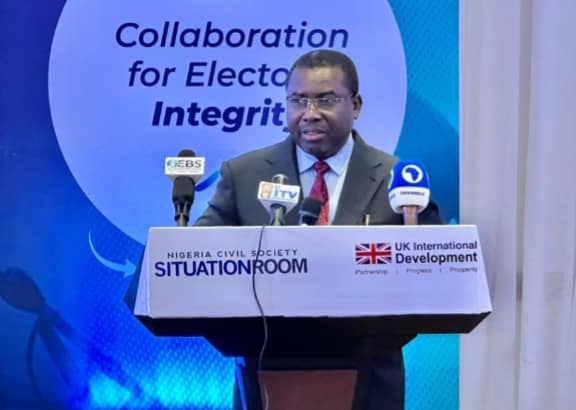
Chairman of the Commission, Professor Joash Amupitan, stated this at the Nigeria Civil Society Situation Room’s Stakeholders’ Forum held in Abuja on Tuesday.
Amupitan who spoke on the theme: “Securing Nigeria’s Democracy: Building Consensus for Credible Elections and Accountable Governance, ” said, INEC’s strategic response to the imperative of credibility election has been the systemic infusion of technology, legally backed by the Electoral Act 2022, into the commission’s electoral system.
“Transparency is the new baseline for trust in our process. However, technology is not a panacea. The nation’s telecommunications network remains a formidable obstacle. With over 176,000 Polling Units, some of which are in remote areas, achieving real-time upload of all results to the IReV remains one of our toughest operational battles.
Related News

“We are therefore, committed to continuous engagement with the Nigerian Communications Commission (NCC) and network providers while actively exploring alternative technologies and building system redundancy to bridge these gaps.
“To secure democracy, technological integrity must be matched by political accountability. We recognise that vote-buying and financial inducement derail the will of the people. To combat this, we have intensified our collaboration with law enforcement agencies through the Inter-Agency Consultative Committee on Election Security (ICCES). The strategic deployment of security personnel and covert intelligence operations at election centres is designed to protect voters from intimidation and resist inducement.
“This is a multi-sectoral fight that requires collective resolve. Civil Society Organisations must play their part decisively to hold all stakeholders, including political parties, to account. The Situation Room, as the leading civil society network, is indispensable in advancing this consensus by monitoring compliance, promoting civic education, and holding the Commission and all actors to the highest standards of the law and procedure”, INEC boss revealed.
Speaking about apathy, he added, “the 2023 General Elections recorded a turnout of just over 27%, a stark reminder that apathy cannot be solved by technology alone. Our recent successes in mobilisation, like the one witnessed in Anambra State, provide a vital roadmap in this regard.
“Only 63.9% of Anambra voters had initially collected their Permanent Voter Cards (PVCs). By proactively extending the PVC collection period across all 326 Registration Areas in the state, we drove the percentage of collected PVCs to an impressive 98.80% of registered voters before the election day.
“We urge all stakeholders, especially civil society organisations and the media, to sustain the momentum and ensure every eligible Nigerian is registered before the final conclusion of the exercise”, he said.
Professor Amupitan equally said that, “credibility is a public trust built only when all stakeholders (political parties, the media, security agencies, civil society, and INEC) agree on, and abide by, the electoral rules and principles. Another one is the accountable governance, this borders on the quality of governance a credible election produces. If the process is just, the government is legitimate, and legitimacy is the bedrock of political accountability. When citizens believe their votes count, they empower themselves to hold their leaders to the highest standards”.
Amupitan ended with this famous quote of Simon Sinek that “Leadership is not about the next election, it’s about the next generation”, he said.