Voice of Reason With Grace Ben Kato
Every 60 seconds, a child somewhere in Nigeria shivers from malaria fever. For many, it is just another bout of illness to be treated with drugs from a nearby chemist. For thousands of others, it is a death sentence.
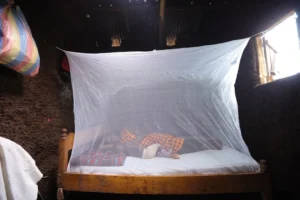
If you grew up in Nigeria in the 1980s, you did not need a doctor to tell you what malaria was. You knew it by the bitter taste in your mouth and the needle that followed. It always started after school. You would drop your bag, your body feeling hot and cold at the same time. Your mother would touch your forehead, then your neck, and hiss or ask, “is your body hot? With series of questions that will follow. She would lift your eyelid to check. If it was yellowish, the verdict was final, you have malaria. Of course, you will be in denial. The fear of five Chloroquine injections and the iching that follows is the beginning of wisdom. The first line of treatment was chloroquine injection or those big, white, terribly bitter tablets that is forced down your throat by your mother who is holding a cane to ensure you do the needful. An attempt to vomit it, will earn you another dose. We had to master the act of swallowing chloroquine without letting it touch our tongue.
And then came the itching. Chloroquine itch. A terrible crawling under the skin that came at night. You would scratch till you bled. That itch was the real punishment for days, for having malaria. Many of us still remember it. That is the reason why we deny having Malaria even when its obvious.
Related News

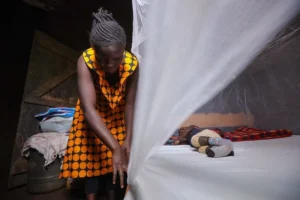
Today the story is different. Today’s children have a chance we never had: a simple white net that can stop the malaria before it starts, and before the dreaded needle comes out.
Despite being preventable and treatable, malaria remains Nigeria’s most ruthless killer. According to the World Health Organisation (WHO 2025), Nigeria alone accounts for 24.3 percent of all global malaria cases and a staggering 30.3 percent of the 579,000 malaria deaths recorded annually worldwide. It is a burden no nation should carry alone, yet Nigeria carries it year after year.
The disease empties classrooms, shuts down markets, leaves farms unattended and drains household incomes. Billions of naira are lost annually to treatment costs, prevention efforts and lost man-hours. In a country battling poverty and a fragile health system, malaria is both a health crisis and an economic brake.
The 2025 Nigeria Malaria Indicator Survey (NMIS), offers a rare piece of good news: malaria prevalence in Nigeria has dropped from 22 percent in 2021 to 15.2 percent in 2025. But with the Nigerian population, it is still high. In Kogi State, where prevalence now stands at 8.9 percent, the figure is even more encouraging.
According to Malaria Consortium State Programme Manager, Okwulu Andrew, at the 2025 Seasonal Malaria Chemoprevention Media Parley in Lokoja, there were 40,678 confirmed malaria cases in children under 5 years in Kogi State in 2024, 683 were severe malaria cases that led to hospitalisation and
12 deaths recorded among children under five from malaria. He noted the actual figure may be higher due to underreporting.
What is driving this decline? Experts point to one simple, cost-effective tool: the Insecticide-Treated Net (ITN). Studies show that consistent use of ITNs reduces malaria incidence by 50 percent in sub-Saharan Africa, the region that accounts for over 90 percent of global cases. A net, hung properly and tucked well over a sleeping area, becomes a physical and chemical barrier between a sleeping child and an infected mosquito. It is cheap, it is effective, and it saves lives every night.
This is where organisations like Malaria Consortium have become critical to Nigeria’s eradication push. Malaria Consortium, one of the leading non-profit organisations fighting malaria globally, has partnered with the National Malaria Elimination Programme (NMEP) and state governments to deliver life-saving interventions to the most vulnerable households. Its model is simple but effective: support government to implement mass campaigns, ensure no household is left behind, and promote behaviour change so that nets are not just collected, but actually used.
In Kogi State, that partnership is now in full force. After nine years without a free mass distribution, the state government through its Ministry of Health Malaria Elimination Programme, in collaboration with NMEP and Malaria Consortium, is set to distribute over 3,141,485 ITNs to every household between November 8 and 15, 2026.
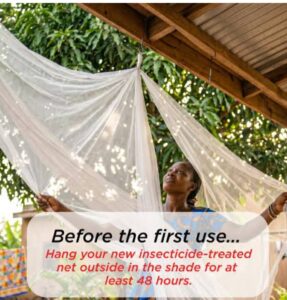
It is more than just distribution. Trained personnel in branded uniforms will go house-to-house to register households, hand over nets, and educate families on proper use — air the net for 24 hours in the shade before hanging, tuck it properly, and sleep inside it every night, all year round. However, beyond nets, comes the real challenge.
Eradicating malaria in Nigeria will require more than nets. It will require consistency. Experts warn that the gains recorded can be reversed if campaigns remain periodic and dependent on donor cycles. Nets get torn, they expire after three years, and in many homes, they are repurposed as fishing nets, window curtains or farm fences.
The real war, therefore, is behavioural. Will Nigerians sleep inside the net every night, even when there is heat, even when there is no buzzing sound of mosquitoes? Malaria Consortium and NMEP have learned this lesson. Alongside distribution, they are investing heavily in community sensitisation — using local languages, religious and traditional leaders, and town announcers to drive home one message: the net only works when you sleep inside it.
Nigeria cannot afford to lose this fight. With a population of over 220 million, achieving zero malaria would not only save hundreds of thousands of lives but would free up resources for education, infrastructure and economic growth. The Kogi campaign, like similar campaigns in Kano, Katsina, Oyo and other states, shows what is possible when government, partners like Malaria Consortium, and communities work together.
For a mother in Lokoja, a farmer in Dekina or a schoolchild in Okene, the solution may not be in a big hospital or an expensive drug, but in a simple white net hanging above their bed. Nigeria’s journey to eradicating malaria is still long. But every night a family sleeps inside an ITN, the country moves one step closer to a malaria-free future
Malaria is as old as humanity. Ancient Chinese medical text Nei Ching (2700 BC), described malaria-like fevers. In 2700 BC to 340 AD, Greeks called it “intermittent fever”. Hippocrates in 400 BC described it in detail and linked it to marshes. Romans called it “mal’aria” — bad air, because they believed it came from poisonous vapours from swamps. For thousands of years, nobody knew what caused it. In 1880, French army doctor, Alphonse Laveran in Algeria, was the first to see the malaria parasite inside red blood cells under a microscope. In 1897, British doctor Ronald Ross, working in Secunderabad, India proved that female Anopheles mosquitoes transmit malaria. He won the Nobel Prize in 1902. In 1898, Italian scientists Bignami, Bastianelli and Grassi proved mosquitoes transmit it to humans. However in 1600s, Jesuit missionaries in Peru, learned that bark of Cinchona tree cured fever. It contained quinine. In 1820, Quinine was isolated and became the first real malaria drug. For 300 years it was the only cure. In 1944, Chloroquine, a synthetic, cheaper drug was developed. In the 1970s, Chinese scientist Tu Youyou, discovered Artemisinin, from sweet wormwood plant (Artemisia annua). It is now the world’s most effective malaria drug. She won Nobel Prize in 2015.
Malaria shaped Africa’s history, it killed European colonists and traders so fast that West Africa was called “the white man’s grave”. In Nigeria, malaria has always been endemic because of our tropical climate, stagnant water and poor drainage, perfect breeding for Anopheles. In the 1950s-60s, WHO tried a global eradication campaign using DDT spraying. It wiped out malaria in Europe and America but failed in Africa. By the year 2000, Abuja Declaration, African Heads of State pledged to halve malaria deaths by 2010. In 2008, Malaria Consortium started work in Nigeria. Today, tools are ITNs (Insecticide-Treated Nets), Indoor Residual Spraying, Seasonal Malaria Chemoprevention (SMC) for children under 5, and new malaria vaccines — RTS,S and R21 approved in 2021-2023.
Malaria history is simple: We have known the killer for 4,000 years, found the cause 145 years ago, found the cure 400 years ago, but we are still fighting it because prevention — nets, clean environment, early treatment — needs people to use it.