By Abdulkarim Abdulmalik
Sometimes, the most compelling and impactful sermon is not delivered from a pulpit; it arrives in the form of an airline ticket.
The reported decision by the Redeemed Christian Church of God (RCCG), under the leadership of Pastor Enoch Adejare Adeboye, to donate $265,854 for the purchase of 500 one-way tickets to evacuate distressed Nigerians from South Africa has therefore done more than provide financial assistance. It has opened a larger conversation about what organised religion should mean in moments of national distress.
The Federal Government has publicly welcomed the intervention, describing it as an expression of compassion, solidarity and commitment to Nigerians caught in the difficulties surrounding renewed xenophobic and Afrophobic attacks in South Africa.
However, beyond the official commendation lies a more uncomfortable question for Nigeria’s enormous religious establishment:
If one church could mobilise such a substantial humanitarian intervention for Nigerians in distress abroad, what should other religious organisations be doing?
Related News

This is not a question about Christian superiority, or should it become an invitation to a competition over who gives the highest donation. It is a challenge about institutionalised compassion.
Nigeria has one of the world’s most influential Christian and Muslim populations. Churches and mosques are not merely places of worship. They are institutions with extensive networks, wealthy members, charitable structures, educational establishments, media platforms and significant influence over public opinion.
That enormous capacity creates enormous responsibility.
The RCCG intervention demonstrates what could happen when religious resources are directed towards an immediate human problem. The money is not being spent on a new auditorium, religious publicity or ceremonial activity. It is being directed towards getting Nigerians who feel unsafe or stranded thousands of kilometres away from home back to Nigeria.
For the person waiting for that ticket, the donation is not an abstract theological statement. It is a lifeline!
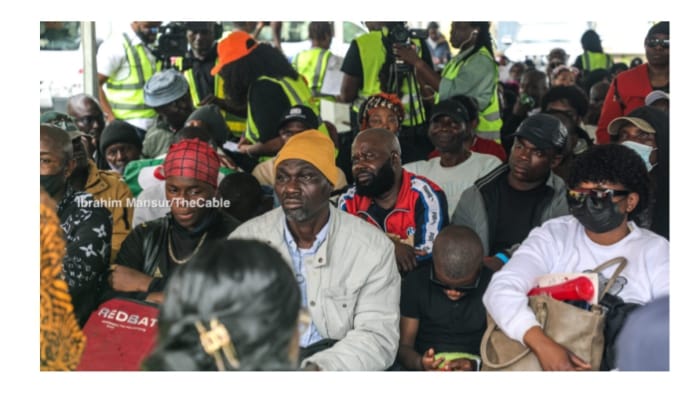
The Federal Government says the evacuation exercise began on June 10, 2026, following renewed attacks against Africans and other foreign nationals in South Africa. The latest figures released by the Ministry of Foreign Affairs showed that 1,640 Nigerians had been brought home, with government financing the return of 1,385 and philanthropic donations supporting another 255 while 202 Nigerians were awaiting final screening by South African authorities. It is against this backdrop that the RCCG’s intervention assumes greater significance.
A challenge to Christian denominations
For Nigeria’s other major Christian denominations, the lesson should not be to ask how they can out-donate RCCG. It should be to ask whether their existing structures could respond quickly when Nigerians face humanitarian emergencies.
Imagine if major denominations maintained permanent emergency-response funds capable of assisting Nigerians affected by conflict, displacement, disasters, persecution, xenophobia or other crises; whether at home or abroad. Such funds could operate professionally, transparently and independently of routine church administration.
That would transform charitable giving from occasional generosity into a permanent humanitarian institution.
The challenge is particularly relevant because churches frequently preach compassion, love, sacrifice and service.
The question is how those values could be converted into structures that work when disaster strikes.
And then comes the Muslim community
The RCCG gesture should also provoke serious reflection among Nigeria’s Muslim organisations.
Islam possesses a remarkably rich tradition of organised philanthropy. Zakat, sadaqah and waqf are not merely concepts for religious instruction. Properly organised, they could become instruments for social protection and humanitarian assistance.
Nigeria has major Islamic organisations, foundations, wealthy philanthropists and extensive networks across the country and the diaspora.
The question, therefore, is not whether Muslims possess the theological foundation for humanitarian intervention. They unquestionably do.
The more important question is whether that philanthropic capacity could be organised with the speed, professionalism and coordination required when Nigerians suddenly find themselves in danger.
This is where the RCCG example becomes a constructive challenge.
The real opportunity is interfaith
The major lesson is neither Christian nor Muslim. It is Nigerian. Human suffering does not ask for a person’s religion or denomination before it arrives.
A Nigerian facing xenophobia in Johannesburg is first a Nigerian. A family displaced by violence in the North is first a human family. A citizen stranded overseas because of a crisis does not become less deserving of assistance because of his or her religion.
That is why Nigeria needs to move beyond an interfaith culture that concentrates primarily on conferences, communiqués and symbolic meetings.
Those things have their place. But there is another level of interfaith engagement: shared humanitarian action.
Imagine Christian and Muslim organisations establishing a joint Nigerian Interfaith Humanitarian Response Fund (NIHRF) capable of supporting citizens affected by emergencies at home and abroad.
Imagine religious organisations working alongside the Ministry of Foreign Affairs, the National Emergency Management Agency, Nigerian diplomatic missions and credible civil society organisations to identify distressed Nigerians and respond quickly.
That would make interfaith diplomacy tangible. It would also demonstrate that religious pluralism is not simply about tolerating one another. Rather, it is about serving humanity together.
Government must also learn from the gesture
The RCCG donation should not become an excuse for government to withdraw from its constitutional responsibility to protect Nigerians. Faith-based philanthropy should complement government; not replace it. The Federal Government remains responsible for diplomatic protection, emergency evacuation and engagement with South African authorities.
Indeed, the Ministry says Nigeria is continuing diplomatic engagement with South Africa over xenophobia and Afrophobia, while Nigerian diplomatic missions remain engaged with affected citizens.
The ideal relationship is therefore partnership. Government provides diplomatic authority and institutional coordination. Faith organisations provide additional resources, community networks and humanitarian reach. Civil society contributes monitoring, advocacy and accountability.
Together, they could achieve more than any one institution acting alone.
Compassion must also be accountable
There is another important observation that must be made clear. Large-scale religious philanthropy requires transparency.
The Federal Government has said it would work with RCCG’s leadership in South Africa to ensure that the donation is properly deployed for the evacuation. That is appropriate.
When hundreds of thousands of dollars are involved, beneficiaries and the public deserve to know that the money reached its intended purpose. Accountability does not diminish generosity. It protects it!
Thus, transparent religious philanthropy could become a model for rebuilding public confidence in charitable institutions.
The bigger question
Ultimately, the RCCG donation presents Nigeria’s religious establishment with a profound question:
What happens when compassion becomes an institution rather than an occasional gesture? That is the real challenge.
The answer should not be another competition between churches and mosques. It should be a race towards greater service.
If RCCG has demonstrated that a major church could mobilise hundreds of thousands of dollars to rescue distressed Nigerians abroad, other Christian denominations and Muslim organisations should examine what they could also contribute; not merely financially, but institutionally.
Perhaps the next humanitarian crisis will produce not one religious organisation responding alone, but dozens working together.
Perhaps the next stranded Nigerian will discover that the country’s religious institutions have established mechanisms that respond before desperation becomes tragedy.
And perhaps one day, when Nigerians hear the familiar language of interfaith harmony, their minds would not flash to another conference. Rather, they will remember the flight ticket graciously provided by RCCG.
Faith, therefore, is most convincing when it does not merely tell a suffering person that God cares. It helps that person get home.
– Abdulkarim Abdulmalik is an Abuja-based Journalist and Chairman, Governing Board, Guild of Interfaith Media Practitioners Nigeria (GIMP-Nigeria).