By Balogun Omeiza David
There is a time when society must stop calling a spade a farm implement when it is glaringly a spade. The activities of vandals and scrap metal scavengers across Nigeria are becoming a clear and present danger to public infrastructure, private property and, ultimately, human lives. What started in many places as the harmless business of picking discarded metals has, in some cases, metamorphosed into an organised appetite for dismantling anything made of iron, steel, copper or aluminium. The latest incident in Lagos State should therefore not be treated with kid gloves. Vandals have gone haywire, and if their activities are not checked with the full weight of the law, the chickens will eventually come home to roost.
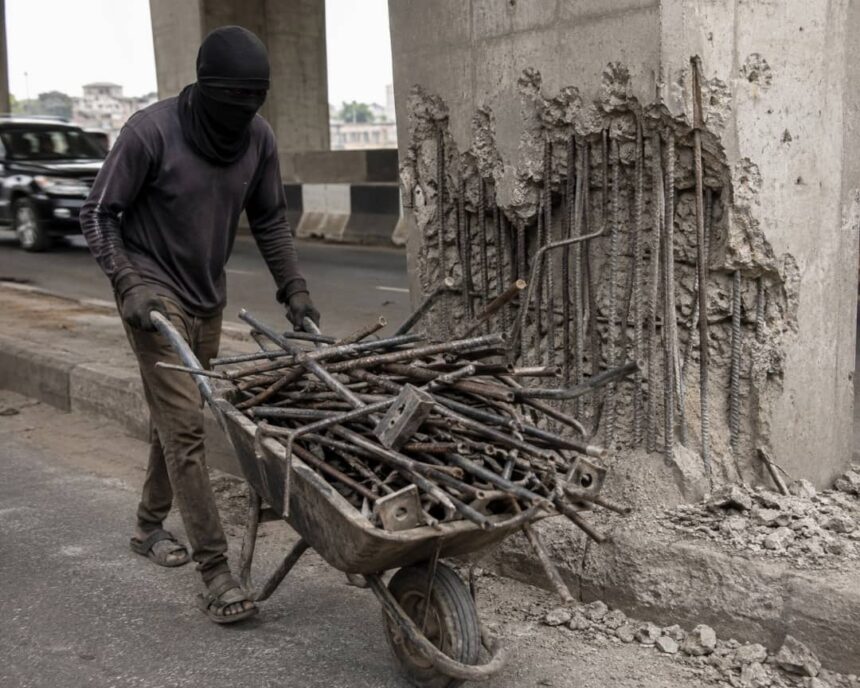
The incident involving the bridge linking Festac Town to Alakija along the Lagos-Badagry Expressway axis is particularly alarming. Suspected vandals and scrap metal scavengers reportedly broke into the concrete structures of the bridge’s supporting pillars in an attempt to harvest the embedded iron rods, steel reinforcements and cables. In other words, these fellows were not merely picking up abandoned scraps from the roadside; they were allegedly tearing into the very bones of a public structure on which human lives depend. This can simply be seen as madness masquerading as a means of fetching a source of livelihood. How on earth can anybody have the audacity to break the pillars supporting a flyover bridge simply because there are iron rods inside? That is cutting the nose to spite the face.
The Lagos State Government and security operatives, including the Rapid Response Squad and Kick Against Indiscipline personnel, deserve commendation for the midnight operation that led to the arrest of more than 27 suspects. Governor Babajide Sanwo-Olu’s inspection of the site and his assurance that the structural integrity of the bridge remains safe are also important steps in calming public anxiety. His directive for immediate remedial repairs and a stronger crackdown on those who buy stolen public infrastructure sends a message that cannot be ignored. The war against vandalism must not end with the arrest of the man carrying the stolen material; it must extend to the people who create the market for the stolen goods. After all, if there were no buyers, many of the thieves would have nowhere to take their loot.
But the Lagos bridge incident is only the tip of the iceberg. Across the country of which Kogi State is not an exception, vandals have reportedly descended on public and private properties like ravaging locusts on farmlands. Electrical cables are ripped out of buildings and installations. Windows and doors are removed from ongoing construction sites. In some communities, anything made of metal appears to have become fair game. Kitchen utensils are reportedly stolen from people’s compounds simply because they are made of iron or aluminium. Street-light batteries disappear under the cover of darkness, while even the poles supporting the lights are not spared. It is a case of what belongs to everybody belongs to nobody being twisted into a dangerous criminal philosophy.
Related News

Even more disturbing are reports and allegations of criminals stealing children, with babies sometimes being carried away in sacks popularly known as “Ghana Must Go” or their rickety wheelbarrows that you can least suspect can be used carry a stolen baby. Such acts, wherever they occur and whoever is responsible, go beyond vandalism; they are an assault on humanity itself. A child is not scrap metal. A baby is not an object to be transported like stolen iron. Anyone involved in child trafficking or abduction must be hunted down and made to face the full wrath of the law. We must never allow the desperation for money to turn human beings into commodities.
It is important, however, to make a distinction between criminality and ethnicity. Some communities have raised concerns about vandals and scrap scavengers who are predominantly from particular migrant or pastoral backgrounds, including Hausa/Fulani individuals. But criminality has no tribe, religion or ethnicity. There are Nigerians from virtually every ethnic group capable of committing crimes, just as there are decent, hardworking and law-abiding Hausa/Fulani citizens who have nothing whatsoever to do with vandalism. A criminal should be identified by his conduct, not by the tribe written on his forehead. Painting an entire ethnic group with the brush of criminality is both unjust and counterproductive. Such a stereotype is what all of us must frown at. The target should be the vandal, the trafficker, the receiver of stolen goods and the criminal network behind the operation.
This is where community policing becomes not just desirable but indispensable. We cannot continue to sleep with one eye closed like the fish inside water while criminals operate under the cover of darkness. A popular Ebira proverb made us to understand that, “When the house is on fire, one does not sit down to debate whose bucket should be used to fetch water to quench the raging fire.” Communities must know who comes into their neighbourhoods, what activities take place in abandoned spaces, where suspicious metals are being stored and who regularly buys materials that could not reasonably have been obtained legitimately. Residents should have functional channels for reporting suspicious activities, while security agencies must respond promptly to credible information. Security cannot be left entirely to government; it is a collective responsibility.
And let us not forget the buyers. The man who steals a street light battery is certainly a criminal, but the person who knowingly purchases that battery at a ridiculously cheap price is not an innocent businessman. He is part of the chain that promotes the wreckless activities of the scavengers. The receiver of stolen public property is the oil that keeps the engine of vandalism smoothly running. Therefore, the authorities must go beyond chasing the boys pushing wheelbarrows and investigate the warehouses, scrap dealers and middlemen who create the demand. Doing this will bring to pass the saying among the Ebiras that goes this, “Cut the snake’s head and its body will soon become powerless.”
There is also a deeper social question that we must confront headlong. What kind of society are we building when some parents bring children into the world without adequate preparation to feed, educate, train or equip them with useful skills? Giving birth is not the end of parenting; it is only the beginning. A child without education, vocational training, discipline and a meaningful pathway into adulthood can easily become vulnerable to the lure of quick money. Governments, parents, religious institutions, community leaders and civil society organisations must invest more seriously in skills acquisition, technical education and legitimate opportunities for young people to earn a living.
Government, on its part, must also learn that prevention is cheaper than reconstruction. When vandals destroy a street light installation, bridge component, electrical facility or public building, taxpayers ultimately foot the bill for repairs. It becomes a vicious cycle: government builds, vandals destroy, government repairs, vandals return, and the people pay again. That is money going down the drain. A nation cannot make meaningful progress when it is constantly spending today’s resources to repair yesterday’s achievements.
The Lagos bridge incident should therefore serve as a wake up call to every state in the federation. This is not merely a Lagos problem. From one state to another, there are pockets of vandalism taking different forms. Railway components, electrical installations, public lighting equipment, telecommunications infrastructure, water facilities and construction materials have all become targets in different places. If we fold our arms and allow the problem to fester, we may wake up one morning to discover that the very infrastructure meant to connect and protect us has been hollowed out from within.
Our elders in Ebiraland told us in a proverb that, “A time comes when you have to draw the line in the sand for your enemies to know you have a boundary that cannot be crossed.” Anyone caught vandalising public infrastructure must face the full force of the law after due process. Those who buy, store, transport or facilitate stolen public property must equally be held accountable. Security agencies must strengthen intelligence led operations, while communities must embrace responsible vigilance. Government must repair damaged infrastructure promptly and secure vulnerable installations. Parents must do their part, and society must provide young people with legitimate pathways to productivity.
A bridge is not merely concrete and iron; it is a promise that people can travel safely from one point to another. A street light is not merely a pole and battery; it is a promise of visibility and security. An electrical cable is not just copper; it powers homes, hospitals, schools and businesses. When vandals steal these things, they are not merely stealing government property rather, they are stealing from all of us.
Enough is enough. We cannot continue to watch vandals eat away at the foundations of our collective development. If we fail to secure what we have built, we shall remain condemned to rebuilding the same things over and over again. As the saying goes, “A stitch in time saves nine.” Nigeria must stitch this wound before it becomes a festering sore.
Vandals have gone haywire by the day. The response must now go haywire in strength, intelligence, community vigilance and lawful enforcement.