From David Onuoja, Abuja
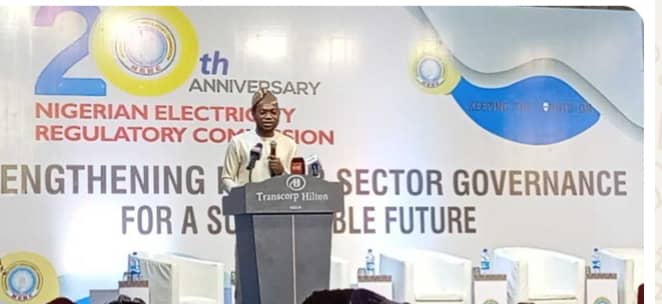
As Nigerian Electricity Regulatory Commission (NERC), marked its 20th anniversary in Abuja, stakeholders gathered to chat way forward for the Power Industry which marked decades of milestone in the sector.
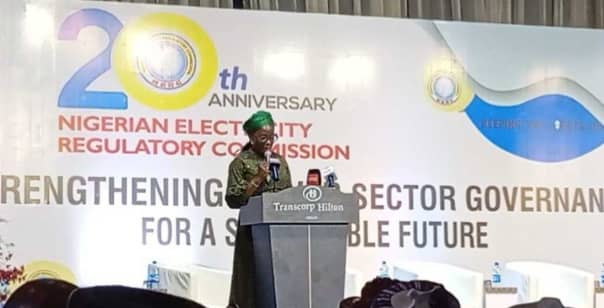
Speaking at the event, the Federal Government through the Minister of Power, Adelabu Adebayo, has reiterated its promised to release the sum of N4trilion, it earlier said will give out to settle the long standing debt owned the power sector.
His word: “addressing the Liquidity Crisis: A decentralized system cannot thrive in an insolvent national market. The government is acutely aware of the debilitating liquidity crisis, with debts to Generation Companies (GenCos), posing a severe threat to sector stability. I am pleased to inform you that Mr. President has recently approved a N4 trillion bond to clear verified GenCos and gas supply debts.”
Related News
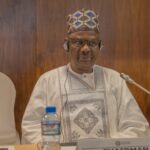
The Minister, equally commended the Regulatory Agency, saying, “Over two decades, the Commission (NERC), has laid the foundation of market stability – developing tariff frameworks, consumer protection mechanisms, and regulatory guidelines that have shaped our power sector’s evolution.
“Achieving Incremental Progress: Some have proposed a strategic, city-by-city approach to achieving steady power, starting with state capitals by 2030”, he said.
On his part, the Group Managing Director of Sahara Power Group, Mr Kola Adesina, while proffering solution, he said, “let’s protect and defend our local investors. Charity must begin at home.
“The people that built America are Americans. The people that built Korea are Koreans. If we treat our own with levity and dignify the foreigners, we are only destroying ourselves and our future.
“There must be alignment of policy with regulation, with laws, decrees, and every other thing so-called. Today, the electricity act we’re praising has elements in it that needs to be remedied very, very quickly. And why? The states don’t possess the wherewithal to build electricity infrastructure.
Talking about possibility and transparency, he said, “So if you are collecting the tariff for band A, you must give band A service. The question is, are we interrogating how to make band A service truly band A in service delivery? The number two thing is that the nation, and this is very important to most of us, especially the investors, the equation of supply of electricity globally, where you have 27 electricity supply, is one where 80% of consumption is industrial and commercial 20% is residential. But today in Nigeria, the reverse is the case. And which is why tariffs are high.
“Another thing that is hindering progress in the electricity sector is “something I need to speak to, before I leave and celebrate this group of people so well, people are stealing power. Why are they stealing power? Most people say it’s metering.
“Let me tell you, as an electricity distributor, my partner is here, BPE. You realize, and we have seen it in our own system, that people that are metered, and most especially the rich, they are the ones bypassing meters. They are the ones stealing electricity.
“The reality of the case, which needs to be interrogated intelligently, is that the incentive for bypass is not so significant for insignificant consumers, it is significant for those who know that they are paying a lot of money, and they can bribe our staff to bypass.
“Another one is the arrangement of sharing in the value-chain, “that arrangement, I beg to say this openly for the very first time, is a bad advert to an international investor, he enumerated.”
Speaking at the event, the World Bank Country Director for Nigeria, Mathew Verghis, called for tougher directives and effective sector governance to fix Nigeria’s power sector. Saying, it is by doing so that the country’s electricity market can thrive in its efficiency, financial sustainability and universal access.
According to him, “Nigeria currently has the largest electricity access deficit in absolute terms globally. The inefficiencies, high losses and limited investments have continued to affect the progress since the power sector was privatised in 2013”, he said.
He however, commended NERC for its role in shaping Nigeria’s electricity landscape through bold policies that have allowed over 7.8 million Nigerians, to gain access to electricity in the past five years through distributed renewable energy initiatives.
Mathew Verghis applauded NERC also for supporting the decentralisation of electricity markets to states and building institutional capacity at the sub-national level through its advisory roles.
While saying that, World Bank will continue to support Nigeria’s efforts in achieving sustainable, inclusive and affordable power for all.
Earlier, the Vice Chairman of NERC, Musiliu Oseni, expressed appreciation to all the stakeholders that contributed to the power sector reform journey and have supported the work of the Commission since its inception.
He said through effective regulation, the Commission has saved the Federal Government several “trillion of naira in subsidies” thereby contributing to improved fiscal position of the government.
According to him, “another key priority area is continuous push for fiscal discipline and transparency at TCN. The Commission shall continue the regulatory process for the transition to bilateral trading, and handholding of the state regulatory commissions for capacity development.
“However, I wish to advise our colleagues at the State Electricity Regulatory Commission to note that regulation is not populism, activism or politics, rather, it requires being objective, analytical, attention to details, having an independent mind and being able to see beyond the surface. You must constantly remember that there must be a utility before you can be called a regulator”, he said.