From David Onuoja, Abuja
The Independent National Electoral Commission (INEC), said, it has completed nine out of the 14 critical milestones in its timetable for the 2027 General Election as the nation enters the final 100 days to the first ballot on January 16, 2027.
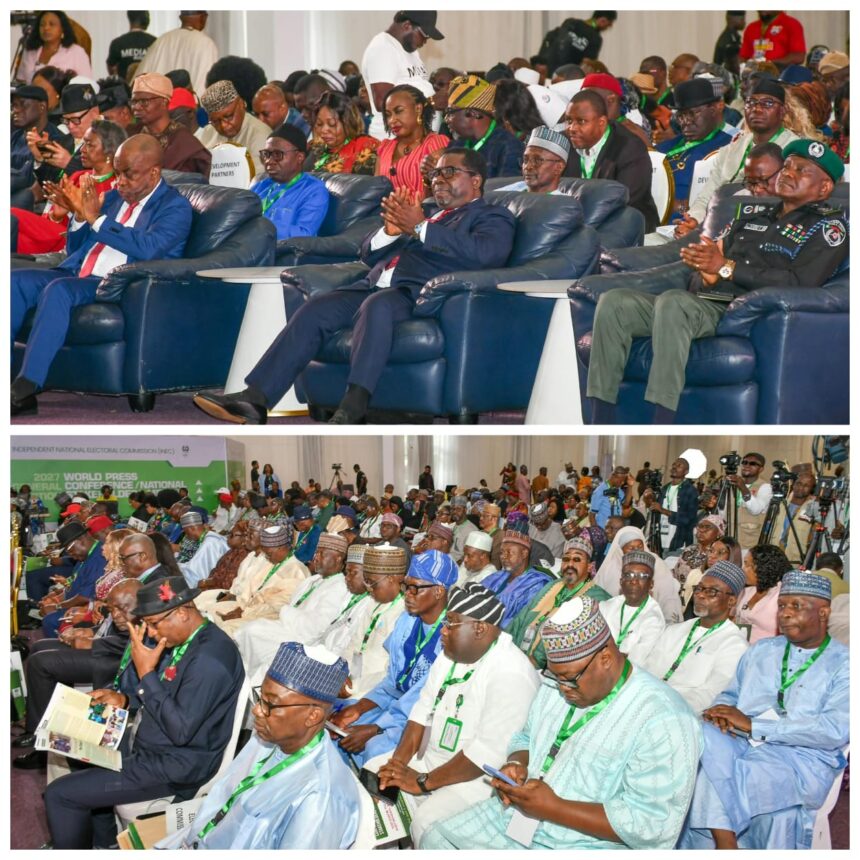
INEC Chairman, Professor Joash O. Amupitan, disclosed this at a World Press Conference and National Stakeholders’ Meeting, held at the BAT-ICC, Abuja. Where he said the Commission has moved from planning to execution, with materials in production and technology undergoing rigorous quality assurance.
On voter register, Amupitan said the Continuous Voter Registration (CVR) which took place in three phases registered about 10.7 million new voters, bringing the National Register to 103 million. Saying, Lagos leads with 7.4 million voters, followed by Kano 6.5 million, while Ekiti has the lowest with 1.05 million. Male voters are 51.7% and female 48.2%, while youths 18-34 years account for 28.7% of the register.
The Chairman said PVC collection for Phase I will commence on October 9, while the register will be displayed for claims and objections from October 9 to 15. He also announced the introduction of Online Registration Portal and Printable PVC technology under the Electoral Act 2026 to eliminate long waits for cards.
Related News
On party nominations, Amupitan said 18 of 22 parties submitted 36 presidential and vice-presidential candidates, while three parties did not nominate presidential candidates and NNPP withdrew. For National Assembly, 1,313 Senate and 3,547 House of Representatives candidates were nominated, while 936 governorship and 9,692 State Assembly candidates were nominated. All 112 complaints on nominations have been resolved except those in court.
On logistics, he described the election as Nigeria’s largest peacetime logistics operation, covering 176,846 polling units in 8,838 wards. INEC said it has renewed MoU with NURTW, RTEAN and Maritime Workers Union for over 100,000 vehicles and 4,000 boats, with special arrangements for riverine and difficult terrains in Niger Delta, Lake Chad and high-altitude areas.
For technology, Amupitan said 57,000 new BVAS devices are in advanced production, with software hardening and battery optimisation. He said the enhanced eEC8A system will ensure result sheets are cryptographically authenticated and uploaded directly to IReV. He also announced creation of an Artificial Intelligence Division with a five-pillar AI Governance Framework to fight deepfakes, voice cloning and cyber intrusion.
On security and anti-vote buying, the Commission said it is deploying its Risk Management Tool and Election Violence Mitigation Tool, while working with ICCES, EFCC, ICPC and NFIU to track illicit campaign spending.
The Inspector General of Police, represented by AIG Police Mobile Force, Alinyenu Idu, assured that clearance operations are ongoing in Kogi, Niger, Benue and Taraba to stabilize flashpoints.
Amupitan disclosed that INEC will require 707,384 ad-hoc personnel for each election day, totalling 1.4 million engagements, to be recruited through INECPRES portal which opened September 18 and closes November 18. Over 70% will be drawn from NYSC, with improved insurance and welfare. He also said Braille ballot guides, magnifying glasses and sign language interpreters will be deployed for Persons With Disabilities, who number 232,658 on the register.
The INEC Chairman warned against disinformation, urging media to establish fact-checking desks and avoid publishing privately collated results, stressing that only INEC has powers to declare results under the Electoral Act.