By Ojotule Romanus
Kogi State Government, says it is committed to strengthening medical education, investments in healthcare infrastructure and manpower development as part of efforts to build a stronger healthcare system capable of competing on the global stage.

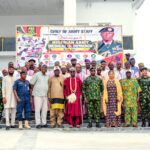
Commissioner for Information and Communication, Hon. Kingsley Fawon, desclosed this in company of his counterpart in the Housing and Urban Development ministry , Hon Taiye Abanika, during an assessment tour of the Medical Students hostels and doctors quarters at the Confluence University of Science and Technology (CUSTHECH), Teaching Hospital Okene.
According to him, the huge investments and infrastructural interventions by Kogi State Government in the training of it’s medical students were aimed at grooming a new generation of medical professionals capable of competing on the global stage.
Related News

This is even as he urged medical students to take advantage of the opportunities provided so as to justify the resources being committed to their training.
He emphasised that the State Government was currently undergoing a comprehensive upgrade of it’s medical training facilities across the state to ensure that students are equipped with modern diagnostic tools and advanced clinical knowledge.

Hon. Fanwo further pointed out that the State Government under the present administration of Governor Ahmed Usman Ododo was committed to strengthening medical education and healthcare delivery.
The inspection provided an opportunity to assess facilities being developed to support clinical training, research and improved healthcare services at the teaching hospital.

Speaking during the inspection, Fanwo described the development as a demonstration of what he called “vision extension,” noting that the transformation of the former Reference Hospital into CUSTECH Teaching Hospital represented continuity in governance and development.
He recalled that the immediate past administration of former Governor Yahaya Bello established the Reference Hospital, while the present administration of Governor Ahmed Usman Ododo has continued to expand its capacity and provide additional facilities required for medical education and clinical services.

According to him, the development demonstrates how projects can be sustained and improved when successive administrations build on existing foundations.
Fanwo expressed satisfaction with the quality of the students’ accommodation and the quartes, highlighting the spacious rooms, reading areas, wardrobes, bathrooms and toilets, as well as the provision of solar power and internet connectivity.

He said the facilities were designed to provide medical students with an environment that would support serious academic work and research, particularly when they progress to the clinical stages of their training.
The Information commissioner further explained that while students in the earlier stages of their programme have accommodation at the CUSTECH campus at Osara, those entering clinical training would have dedicated accommodation close to the teaching hospital.

The Commissioner also stressed the importance of the doctors’ quarters, saying the proximity of doctors to the hospital would enhance clinical response and make it easier for medical personnel to attend to emergencies and other responsibilities at any time.
He linked the initiative to the administration’s broader effort to attract and retain qualified medical professionals in Kogi State, noting that creating a conducive working and living environment is essential to strengthening healthcare delivery.

Fanwo further said the development was part of a wider investment in education and healthcare infrastructure across the state, pointing to ongoing projects at other institutions, including the Prince Abubakar Audu University Teaching Hospital, Anyigba.
In addition, he said government’s investment in medical education was ultimately aimed at producing doctors who could compete professionally anywhere in Nigeria and around the world.
He therefore urged medical students to take their studies seriously and justify the resources being committed to their training.
Fanwo equally noted that the challenge for future administrations would be to sustain the momentum and ensure that projects designed to strengthen medical education and healthcare are not abandoned but expanded to serve generations of Kogi residents.
Abanika, while conducting the delegation around the project site, expressed satisfaction with the standard of the facilities, describing the hostel as more than a conventional student accommodation.
He drew attention to the reading spaces, beds, wardrobes, toilets and bathrooms, explaining that the facilities had been designed with the peculiar needs of medical students in mind.
He then said the accommodation would provide students undergoing clinical training with a comfortable and conducive environment within close proximity to the teaching hospital.