From David Onuoja, Abuja
The Chairman of the Independent National Electoral Commission (INEC), Professor Joash Amupitan, said it has secured the commitment of the National Universities Commission (NUC), to bring out credible academic personnel for the 2027 general election through its nomination and the alignment of university academic calendars with the election timetable.
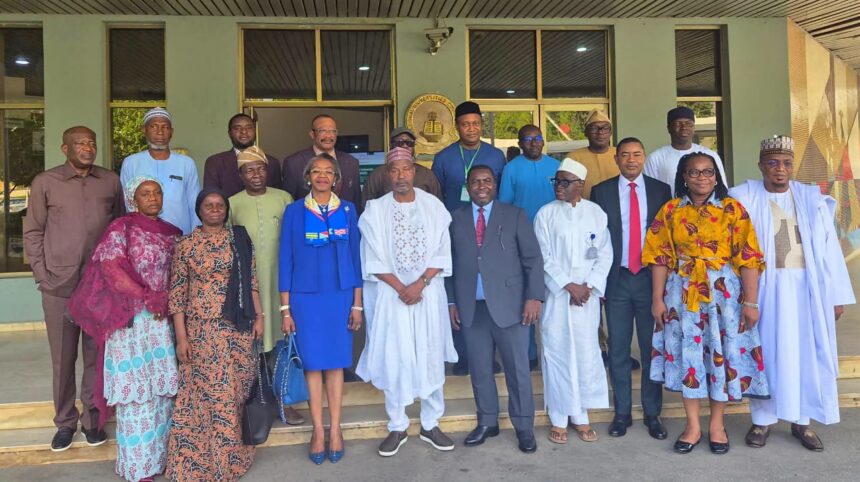
The assurance was given by the NUC Executive Secretary, Professor Abdullahi Yusufu Ribadu, on Monday, in Abuja, during a courtesy visit by the INEC Chairman, who was accompanied by the National Commissioners and Senior officials of the Commission.
Amupitan said the visit was a deliberate strategic partnership at the final operational stretch towards the Presidential and National Assembly elections on Saturday, 16th January, 2027, and the Governorship and State Houses of Assembly elections on Saturday, 6th February, 2027.
He noted that for over a decade, the Nigerian academic community had served as the backbone of collation and declaration of results, with Vice-Chancellors serving as Collation and Returning Officers across the Federation.
Related News

The INEC Chairman said the Commission had introduced operational, technological and security reforms to make the work of its university partners safer and less contentious. Saying, polling unit results on Form EC8A would undergo automated arithmetic consistency and over-voting checks before transmission to the INEC Result Viewing Portal (IReV), while the Commission had procured 57,000 new Bimodal Voter Accreditation System (BVAS) devices and lowered the voter-to-device ratio to 850 per machine. Adding that a nationwide mock accreditation and result transmission exercise would hold across the 36 states and the FCT on Saturday, 28th November, 2026.
On security, Amupitan said the Inter-Agency Consultative Committee on Election Security (ICCES), had been decentralised to every Local Government Area and Registration Area, with dedicated security cordons and escort protocols around collation centres.
He also drew attention to Sections 96 and 97 of the Electoral Act 2026, which criminalise violence, abusive rhetoric and threats against electoral personnel, and Section 148, which empowers the Commission to prosecute offenders directly. “No Returning Officer or Collation Officer will be left to stand alone against lawlessness,” he said.
INEC Chairman also requested NUC’s support in four areas: the timely nomination of academic staff of verified non-partisan standing, the alignment of academic calendars with the election dates, collaboration on voter education and counter-disinformation on campuses, and the welfare and recognition of academics deployed for election duty.
Responding, Prof. Ribadu congratulated Prof. Amupitan on his appointment, describing him as a lawyer and academic of international repute and “a round peg in a round hole”.
He said the NUC would engage Vice-Chancellors on the nomination of academic staff, including through an online meeting, and would transmit a circular to the universities once INEC forwards a formal letter. “Since we want to have credible elections, we also have to have credible personnel,” he said, adding that all ad hoc personnel should take an oath of neutrality.
On the academic calendar, Prof. Ribadu said the entire election cycle would last no more than four weeks, and suggested that universities could adopt a three-to-four-week break to accommodate it. “We will discuss with the Vice-Chancellors and have their calendars tweaked in such a way that it will not affect the elections, nor will it affect the studies of the students,” he said.
Ribadu added that students could support voter education through campus clubs, and proposed expanded collaboration, including student internships at INEC offices, a possible programme in electoral studies, and joint research on artificial intelligence, robotics and data analytics.