From David Onuoja, Abuja
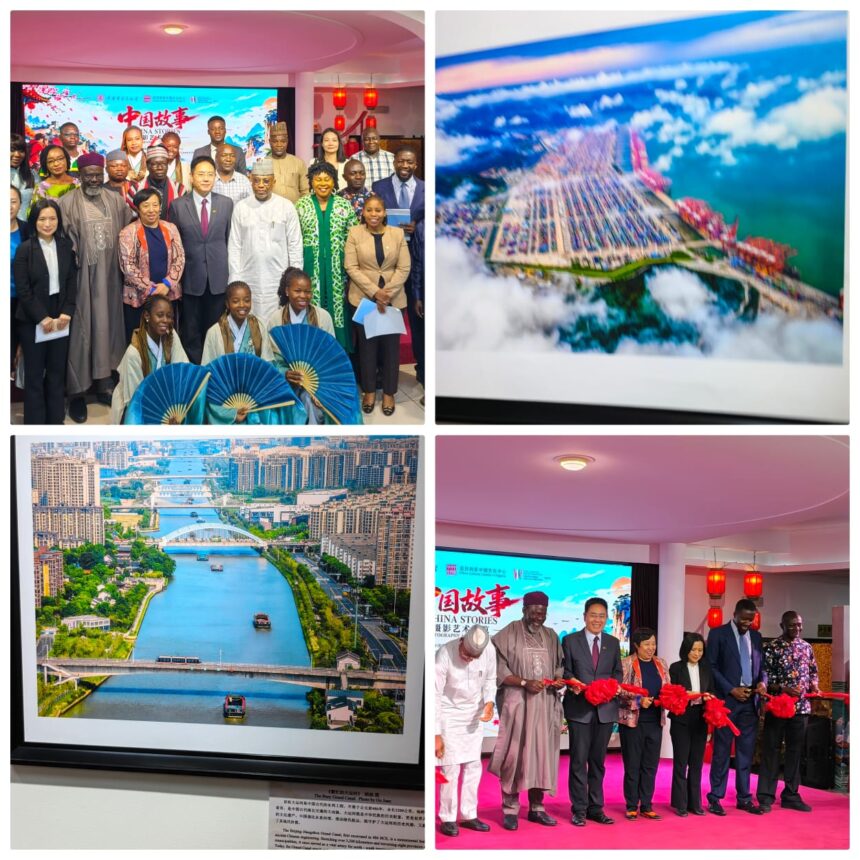
Photography as a bridge between people took centre stage in Abuja, at the opening ceremony of the “China Stories” Photography Exhibition, where speakers from China and Nigeria celebrated culture, patience and 55 years of diplomatic friendship between the two countries.
The exhibition, organised to implement the outcomes of the 2024 Beijing Summit of the Forum on China-Africa Cooperation and put the Global Civilization Initiative into practice, drew diplomats, artists, government officials and photographers to the China Cultural Centre in Nigeria.
In his remarks, the Cultural Counselor of the Chinese Embassy in Nigeria and Director of the China Cultural Centre, Mr. Yang Jianxing, described photography as an art form that transcends language and national boundaries, capturing the spirit of an era, conveying human emotions and connecting hearts and minds.
He said the China Photographers Association has played an important role in documenting China’s economic and social development, telling China’s stories, promoting exchanges and mutual learning among civilizations, and fostering closer bonds between people, adding that the delegation’s long journey to Nigeria speaks volumes about mutual respect and learning between the two countries.
Related News

Mr. Yang used the occasion to give an overview of China’s development, noting that this year marks the 105th anniversary of the founding of the Communist Party of China (CPC), which has united and led Chinese people of all ethnic groups in achieving national independence and building a prosperous country, creating two remarkable miracles: rapid economic development and long-term social stability.
The Counselor/Director of the China Cultural Centre said since reform and opening-up in 1978, China’s economy grew at an average annual rate of 8.9 per cent between 1979 and 2023, far above the global average of 3.0 per cent, while China’s average annual contribution to global economic growth reached 24.8 per cent, ranking first in the world.
He added that China’s share of the global economy rose from approximately 1.7 per cent in 1978 to 16.5 per cent in 2025, with GDP reaching approximately 17.8 trillion US dollars, making China the world’s second-largest economy, and that in 2025, GDP hit RMB 140.19 trillion, equivalent to about 20.28 trillion US dollars, representing 5.0 per cent growth.
According to him, China now accounts for roughly one-sixth of the global economy and is expected to have contributed around 30 per cent of global economic growth in 2025, while World Bank data shows that nearly 800 million people have been lifted out of extreme poverty in almost four decades.
Mr. Yang also noted that since entering the new era in 2012, China has pursued high-quality development, improved living standards, education, healthcare, social security and environmental protection, and said the photographs on display are vivid reflections of those achievements, while also highlighting the Fifth Plenary Session of the 20th CPC Central Committee and China’s zero-tariff treatment for 53 African countries, including Nigeria, implemented in May this year.
Speaking for Nigeria, the Permanent Secretary, Federal Ministry of Art, Culture, Tourism and Creative Economy, Abdulkarim Ozi Ibrahim, who represented the Minister, said photography is more than pictures, it is memory, history, and how a nation tells its story to the world.
He said Nigeria and China have a growing friendship rooted in old, rich and proud cultures, and that when a Chinese photographer takes a picture in Abuja or a Nigerian photographer takes a picture in Beijing, Shanghai or Xi’an, they are not just taking photographs, they are building bridges between peoples.
Mr. Ibrahim told a story of patience in photography, recalling an old photographer who waited hours at sunrise in the savannah for a lion, and was told by his impatient assistant to leave, only for the lion to appear in perfect golden light, producing one world-famous picture.
Perm-Sec., said the lesson is that the best picture is not taken by the fastest hand but by the most patient hand, adding that a photographer must be patient with nature, people, light and culture, because culture does not reveal itself in a hurry, and that Nigeria admires the Chinese tradition of patience, discipline and respect for beauty.
He equally assured the Chinese delegation of the Ministry’s full support for cultural exchange, exhibitions, training and creative collaboration, and said Nigeria intends to learn from the exhibition and open a new chapter where Nigerian and Chinese photographers will work together and tell the story of their friendship to the world.
In his remarks, the Deputy Secretary General of the China Photographers Association, Ms Chen Jin who also welcomed guests on behalf of the Embassy and the Cultural Centre, thanked the Association for its full financial support for the event and the five representatives who travelled over 10,000 kilometres to Nigeria.
He reiterated that photography transcends language and national boundaries, and that the exhibition is a vivid example of joint efforts to implement the FOCAC outcomes, while recalling a visit to a modern photo studio in Abuja the previous day as a sign of deepening professional exchange.
Ms Chen Jin also marked the 77th anniversary of the People’s Republic of China and the 105th anniversary of the CPC, noting that reform and opening-up, which began in 1978, is two years older than him, having been born in 1980, and that China’s share of the global economy rose from 1.7 per cent in 1978 to 17.5 per cent in 2025.