From David Onuoja, Abuja
The Director of BudgIT Foundation, Oluseun Onigbinde, ably represented by the Country Director, Vahyala Kwaga, has said that only about N7b was budgeted and allocated to about 35 million Persons With Disabilities (PWDs) in the Country.
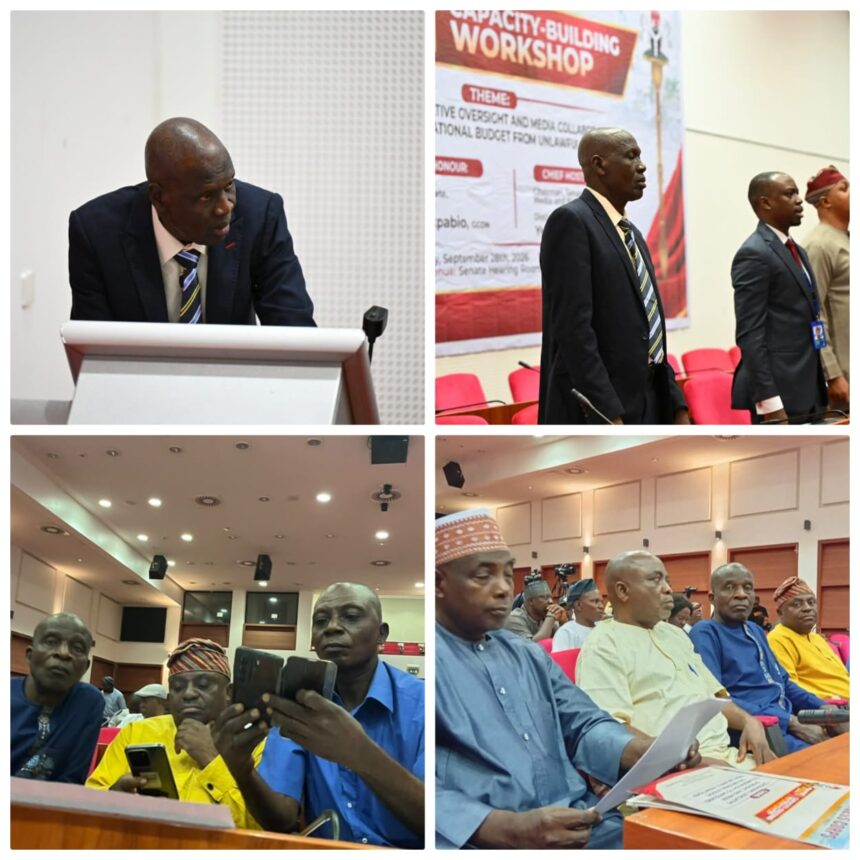
He made the revelation during the Senate Press Corps 2026 Capacity-Building Workshop, with the theme: “Leveraging Legislative Oversight and Media Collaboration to Safeguard the National Budget from Unlawful Insertions”.
Onigbinde who spoke on the role of the National Assembly in evaluating the budget proposal said, it is a pity that that small amount of money was budgeted for Disabilities in Nigeria.
He equally spoke on the budget scrutiny by the National Assembly which he said is too often focused on appropriations rather than on public policy performance, which should be a critical component of the legislative budget process.
Related News
Onigbinde analysed the persistent challenges affecting Nigeria’s budgeting process from the perspectives of the different arms of government.
On the part of the Executive, he identified the late submission of the Medium-Term Expenditure Framework and Fiscal Strategy Paper (MTEF-FSP) to the National Assembly for scrutiny as a recurring challenge. Arguing that the delay often results in expenditure projections exceeding credible available resources.
The BudgIT boss director therefore, recommended for the early submission of the budget proposal to the National Assembly, noting that effective legislative scrutiny cannot take place without sufficient time to review the proposal. He also recommended that the budget be submitted to the National Assembly at least 90 days before the end of the financial year.
BudgIT also recommended that the National Assembly assess the performance of an agency’s previous budget before approving a new allocation. While calling for stakeholder participation in the budget proposal and review process.
In his goodwill message, the Special Guest of Honour, who is the Senate President, Godswill Akpabio, who was represented by Senator Yemi Adaramodu, called for balanced reportage by the Press in order to gain public confidence and trust in the national budget.
Akpabio urged parliamentary journalists to familiarize themselves with legislative processes and procedures in order to ensure accurate reporting.
He equally charged the media to continue to act as watchdogs to expose waste and ensure proper utilization of public funds.
The Honorable Minister of Budget and National Planning, Senator Atiku Bagudu on his part, spoke on the role of the executive, especially his office, in preparing the national budget and proper scrutiny to avoid illegal insertions.
He explained that Nigeria’s national budget is the smallest among the 10 largest countries in the World. Saying, as at the time President Bola Tinubu took over the government, the country in terms of revenue had the lowest revenue GDP ratio.
The Minister maintained that the Tinubu administration is ensuring that the country increases its national budget to a one trillion dollar economy, while taking cues from other developed countries.
Bagudu specifically said Nigeria is targeting to have the same budget size with Brazil whose national budget is 20 times bigger than that of Nigeria.
Urging the media to help Nigerians understand why particular projects and expenditures appear in the budget, noting that some items may reflect genuine needs in communities that are not immediately obvious.
He also supported continued vigilance against unlawful insertions and budget errors, but called for proper verification before drawing conclusions.
Earlier in his welcome address, the Chairman of the Senate Press Corps, Mr. Taiye Odewale, said the alleged N1.3bn allocation to the non-existent Presidential Foreign Intervention Promotion Council (PFIPC) in the 2026 budget exposed the need for stronger checks against unlawful budget insertions.
Odewale said, the Senate Press Corps’ findings showed that the allocation was not part of the N9.853tn added by the National Assembly to the N58.47tn Executive proposal that produced the N68.32tn 2026 budget.
He said the controversy prompted the workshop to strengthen collaboration between legislative oversight and the media in detecting questionable budget