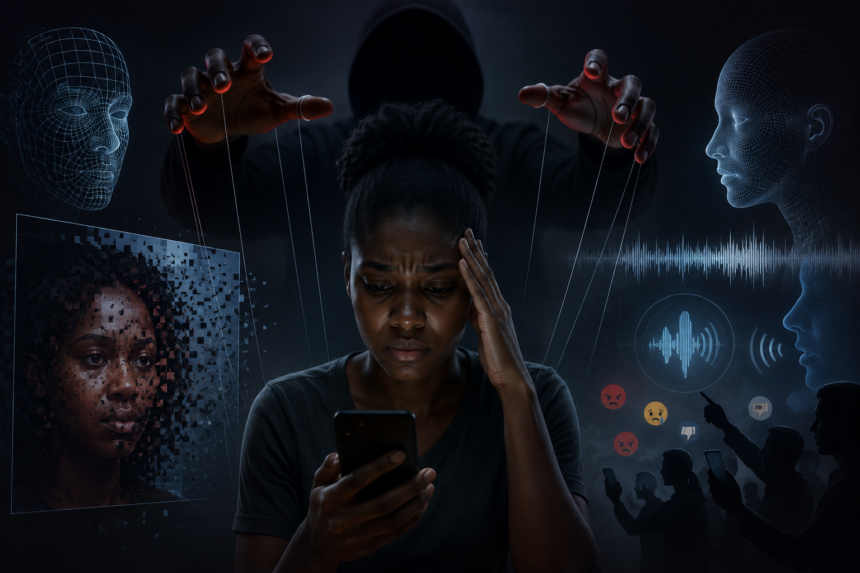
By Victoria Okpanachi
There is a popular saying that, “everything that has an advantage also has a disadvantage”? Well, that saying couldn’t be more true, especially here in Nigeria, where we often take things to the extreme, whether it’s for good or bad. Take Artificial Intelligence (AI), for instance. Since it became a household topic, many people have been singing its praises. It is so efficient, smart, and it makes life a lot easier.
Technology, after all, is meant to improve our lives. But let’s not kid ourselves. AI has its dark side too. For some people, it’s no longer just about smart chatbots and cool filters, it has become a nightmare. We’ve heard stories about people using AI in ways that are disturbing and harmful. Just recently, a popular Nigerian content creator, Asher Kine, was out creating one of his usual videos when he bumped into a young woman named Rebecca at the University of Nigeria, Nsukka (UNN). During their casual chat, he asked her the kind of harmless question people ask in such content: “Do you have a boyfriend?” To which she smiled and said, “No, I don’t.” What began as an ordinary day on social media turned into a traumatic experience for the young woman. A selfie video she made prior to that time went viral but with a shocking twist.
A young man named Kehinde, who wasn’t part of the original video and hardly even knew Rebecca, had somehow inserted himself into the video and posted it as a picture on social media after much editing claiming to be the lady’s boyfriend. Using AI tools, he digitally edited the clip to make it appear like he and Rebecca were a couple. Just like that, her name was dragged into a web of lies. People criticised her badly, some said she denied the alleged boyfriend because he is poor. The photo went viral, Facebook, Instagram and TikTok, and before long, Rebecca’s phone was flooded with messages, from curious friends, nosy classmates, and complete strangers. Some mocked her, others judged her. She hadn’t done anything wrong. She didn’t even know this boy from anywhere. But now, thanks to AI and one person’s selfish act, her image and dignity were on trial in the court of public opinion.
AI is no longer something from science fiction films. It’s here, it’s powerful, and it’s dangerous in the wrong hands. What happened to Rebecca is becoming more common every day, not just among young people, but across workplaces, politics, religion, and even families. With tools that are freely available on the internet, anyone can create a fake story and make it look real.
One of the most terrifying tools in this trend is voice cloning.
Related News

AI systems today can now copy someone’s voice almost perfectly using just a few seconds of their speech. All it takes is a short voice note, a YouTube interview, or even an Instagram story and someone can use it to generate a fake voice note saying anything.
Think about that for a moment. Your own voice, copied and used to say things you never said. Imagine a voice note going viral, where you appear to insult someone, confess to a crime, or say something embarrassing, when in fact, you never uttered a word of it.
It’s already happening. In some secondary schools, students have been suspended based on fake voice notes. In workplaces, people have been accused of making offensive comments that were never actually spoken. During elections, politicians have been “caught” in audio leaks that were nothing more than cleverly crafted AI recordings.
In one recent case in Lagos, a man was accused of trying to scam his boss after an AI-cloned voice note was sent from his number, asking the company accountant to send funds to a false account. He only escaped trouble because the bank flagged the transaction and asked questions. But not everyone is so lucky.
We live in a world now where you can no longer trust what you see or hear.
The sad truth is that technology, in and of itself, is not the enemy. AI can be a wonderful tool. It helps doctors diagnose patients faster. It supports learning in schools. It helps businesses work smarter. But in the hands of someone with a wicked heart or a selfish motive, it becomes a silent, digital weapon, one that can destroy lives without ever drawing blood.
What’s more painful is that many people still fall for these tricks. Our society loves sensational stories, especially those that are scandalous. Once something “looks” or “sounds” real, people don’t bother to verify it before forwarding it to ten others. We help these digital lies grow simply because we don’t pause to ask questions.
So what can we do? First, we must educate ourselves and others. Digital literacy is no longer a luxury, it’s a necessity. Everyone, from schoolchildren to elderly parents, needs to understand how easy it is to fake a video or voice recording. We must stop believing that every image or audio clip is true just because it looks or sounds convincing.
Parents should speak to their children about digital safety. Schools should include media literacy in the curriculum, teaching students how to detect deepfakes and protect their online identities. Churches, mosques, and community centres should hold awareness sessions too, because no one is safe from AI manipulation. We also need stronger laws. Right now, Nigeria has laws against cybercrime and defamation, but they don’t fully cover AI-generated content.
We need clear regulations against voice cloning, deepfakes, and other forms of digital impersonation.
People like Kehinde should face serious consequences, not just social backlash, but legal punishment, for what they do. Then finally, tech companies must take responsibility. The apps that allow AI-generated content must build clear systems for watermarking, labelling, or tagging AI content, so users know what’s real and what’s artificial.
Social media platforms just like facebook has done, must improve their detection tools to flag manipulated content early. But above all, we, the users, must do better. Before you share a video or voice note, pause. Ask: Could this be fake? Is there proof? Could sharing this hurt someone’s reputation? If we don’t become more careful, we will keep enabling the destruction of people’s lives, all in the name of content.