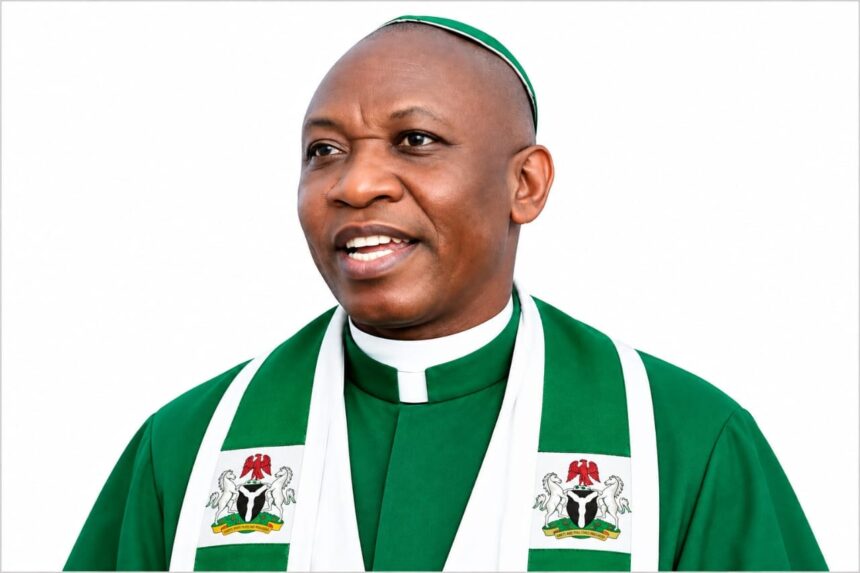
The President of the International Fellowship of Ecumenical Ministries (IFEM), Archbishop Osazee Williams, has urged the Federal Government, to make the teaching of Nigeria’s national anthem an integral part of education as the country celebrates its 66th Independence anniversary.
Williams said merely reciting “Nigeria, We Hail Thee”, during school assemblies was insufficient, stressing that pupils and students should be taught the meaning, history and civic values embedded in the anthem.
In a statement on Thursday, the cleric said the anthem could serve as an important tool for promoting national unity, peaceful coexistence and responsible citizenship among young Nigerians.
He particularly cited the line, “Though tribe and tongue may differ, in brotherhood we stand,” describing it as a lesson in unity for a country characterised by ethnic, religious and regional diversity.
According to him, the message of brotherhood should go beyond acknowledging differences to encouraging Nigerians to regard one another as members of one national community.
Related News
“We are teaching them to sing a song of hope without understanding the weight of its promise,” Williams said.
The IFEM president described the anthem as “a national covenant” that expresses a commitment to fellow citizens and the aspirations of the country.
He said the opening line, “Nigeria, we hail thee, our own dear native land,” should encourage students to learn the nation’s history and develop a deeper appreciation of their homeland.
Williams also said the line, “Nigerians all, and proud to serve our sovereign Motherland,” could provide a basis for teaching civic responsibility and the importance of service.
“Service is not just a career, but a character. Pride is not just a feeling, but a responsibility,” he said.
The cleric urged educational authorities to incorporate the themes of the anthem into subjects including history, civic education and literature from primary to tertiary levels.
He further called for the history of “Nigeria, We Hail Thee” to be taught alongside its lyrics, noting that it was adopted at independence in 1960, replaced in 1978 and restored in 2024.
Williams said understanding the anthem’s evolution would help young Nigerians appreciate its significance and the reasons behind its adoption, replacement and restoration.
He urged schools to use the anthem to stimulate discussions on its vision of a Nigeria where “no man is oppressed” and where “peace and plenty” are enjoyed by all.
“Teaching the anthem is not about rote memorisation. It is about nation-building,” he said.
Williams also called on parents, religious organisations and other stakeholders to support efforts to use the national anthem as part of broader initiatives for unity, peaceful coexistence and responsible citizenship.
He said the 66th Independence anniversary provided an opportunity for Nigerians to reflect on whether they were simply singing the anthem or genuinely understanding and living by the values it represents.